
Osama bin Laden (10 March 1957 – 2 May 2011) was the founder and first general emir of al-Qaeda. A pan-Islamist and Islamic extremist, bin Laden organized and funded numerous jihadist or anti-Western militants and terrorist attacks worldwide. Al-Qaeda's September 11 attacks in 2001 against the United States directly killed 2,977 victims, and began America's global war on terror.
Osama bin Laden | |
|---|---|
أسامة بن لادن | |
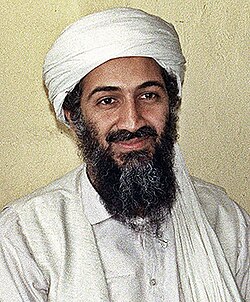 Bin Laden, c. 1997–1998 | |
| 1st General Emir of al-Qaeda | |
| In office 11 August 1988 – 2 May 2011 | |
| Preceded by | Position established |
| Succeeded by | Ayman al-Zawahiri |
| Personal details | |
| Born | 10 March 1957 Riyadh, Saudi Arabia |
| Died | 2 May 2011 (aged 54) Abbottabad, Pakistan |
| Cause of death | Gunshots to the head and chest |
| Resting place | Arabian Sea |
| Citizenship |
|
| Spouses | Najwa Ghanem (m. 1974; sep. 2001)Khadijah Sharif (m. 1983; div. 1990)Khairiah Sabar (m. 1985)Siham Sabar (m. 1987)Amal Ahmed al-Sadah (m. 2000) |
| Children | Around 20 to 26 |
| Parents |
|
| Relatives | Bin Laden family |
| Education | Al-Thager Model School King Abdulaziz University |
| Religion | Sunni Islam |
| Jurisprudence | Hanbali |
| Military service | |
| Allegiance | Maktab al-Khidamat (1984—1988) al-Qaeda (1988—2011) |
| Years of service | 1984–2011 |
| Battles/wars | |
Bin Laden was raised into Sunni Islam by his wealthy family in Saudi Arabia. He left the country to help the Afghan mujahideen fight the Soviet Union in the Soviet–Afghan War (1979–1989), and in 1984, he co-founded Maktab al-Khidamat, which recruited foreigners into the mujahideen. In 1988, bin Laden founded al-Qaeda to enact violent jihad worldwide. When the Soviets withdrew from Afghanistan in 1989, he returned to Saudi Arabia. His public beliefs led to his 1991 expulsion from the country, upon which he moved with al-Qaeda to Sudan. Bin Laden helped start the Algerian Civil War (1992–2002), in which he aided the GSPC, and he also aided the Bosnian mujahideen in the Bosnian War (1992–1995). Sudan expelled him in 1996, and he moved with al-Qaeda to Afghanistan, soon governed by the Taliban. Al-Qaeda allied with them in the 1996–2001 Afghan Civil War.
After 1991, Saudi Arabia allowed American troops to station in Saudi territory for years; bin Laden declared war on the majority-Christian U.S. in 1996, viewing Muhammad as having banned disbelievers in Islam from permanent stay in Arabia. Al-Qaeda bombed the World Trade Center in New York City in 1993, U.S. embassies in Africa in 1998, and a U.S. Navy ship in 2000. Al-Qaeda in Yemen, later named al-Qaeda in the Arabian Peninsula, has waged an insurgency in Yemen since 1998.
9/11 was mainly planned by bin Laden and Khalid Sheikh Mohammed, who were possibly financed by Saudi Arabia. The attacks destroyed the World Trade Center, causing over 6,000 deaths from inhalation exposure. An international manhunt for bin Laden began. The U.S. invaded Afghanistan, starting the 2001–2021 War in Afghanistan; they deposed the Taliban government, forcing bin Laden to move to Pakistan. Al-Qaeda allied with the subsequent Taliban insurgency, which took back the country in 2021. Al-Qaeda continued enacting major terrorist attacks, such as in Indonesia in 2002, Turkey in 2003, England in 2005, and Jordan in 2005. The U.S. falsely claimed that the Iraq was involved in 9/11 to justify invading Iraq in 2003. The resulting Iraq War (2003–2011) involved Iraqi insurgent groups, especially al-Qaeda in Iraq (later named the Islamic State of Iraq).
In 2011, U.S. troops killed bin Laden at his compound in Pakistan, and Ayman al-Zawahiri became al-Qaeda's emir. Polls show that Muslims at large have a negative view of bin Laden, although many Islamists consider him to be heroic. Elsewhere, he is overwhelmingly seen as a symbol of terrorism and mass murder.
Names
Bin Laden's name is most frequently romanized from Arabic as Osama bin Laden, but can also be spelled with the names Usama and bin Ladin. During his life, U.S. intelligence internally referred to him as Usama bin Laden, acronymizing it as "UBL".Osama was named after Usama ibn Zayd, one of the companions of Muhammad; the name means "lion".Bin, also spelled ibn, means "son of" in Arabic. Osama's full name, as spelled here, is Osama bin Moḥammed bin Awad bin Laden—"Osama, son of Mohammed, son of Awad, son of Laden".Mohammed is his father, referred to here as Muhammad bin Ladin.
The Arabic linguistic convention would be to refer to Osama as Osama; Osama bin Laden; or similar romanizations, not bin Laden alone, as bin Laden is a patronymic surname, not a surname in the Western manner. In the West, he is nonetheless nicknamed bin Laden, which often begins sentences about him ("Bin Laden was..."), although, being at the start of a sentence, ibn would be more accurate to Arabic ("Ibn Laden was...").
Bin Laden also went by Osama bin Muhammad bin Laden; Shaykh Osama bin Laden; Mujahid Shaykh; the Prince; the Emir; Hajj; the Director; and Abu Abdallah. A mujahid, plural mujahideen, is a participant in jihad—struggle in the name of Islam (peaceful or violent).Hajj is the traditional pilgrimage of Muslims to the holy city of Mecca.Abu Abdallah is a kunya, a parent's name based on their child's; Abu means "father of", and Abdallah is his son.
In many instances, outlets such as BBC News and The Washington Post have mistakenly referred to Osama as Obama bin Laden, confusing his name with that of American president Barack Obama. The similarity of their names is likely a key reason behind conspiracy theories that Obama is an Islamic extremist.
Early life
Osama bin Laden was born on 10 March 1957 in Riyadh, Saudi Arabia. Despite it being generally accepted that his birthplace was Riyadh, which he himself claimed, FBI and Interpol documents formerly listed it as Jeddah. His father Muhammad was born in modern Yemen. Osama's mother, Alia Ghanem (later Hamida al-Attas), was born in Syria. She was Muhammad's tenth wife. Osama was the 17th of Muhammad's ~52 children, and the only one of Muhammad's marriage to Ghanem.

The bin Laden family originates with "Sheik Mohammed bin Laden", a Sunni Muslim from modern Yemen, who moved to modern Saudi Arabia in the early 20th century. From the 1950s to 70s, Osama's father Muhammad became immensely wealthy from his construction company, the Saudi Binladin Group. Its clients included the Saudi royal family, the House of Saud. The royals gave it the exclusive right to construct religious buildings in their country. This included the renovation of Mecca, after which it became the House of Saud's official construction contractor. Around this time, Muhammad's sons started going to the same schools as the royal sons. The bin Laden family still owns the Saudi Binladin Group, and still has ties to the House of Saud. Osama later inherited from his family around $25–30 million in 2011 USD.
Six months after Osama's birth, he and his parents moved to the Saudi region of Hejaz, which includes the two holiest cities in Islam, Mecca and Medina. He lived there until adulthood. His parents divorced in 1960. Alia then married Mohammed al-Attas, an employee of the Saudi Binladin Group, in the early 1960s. The two had four children, and raised them alongside Osama in a new house. In 1967, Muhammad bin Ladin died in an airplane crash in Saudi Arabia.
From 1968 to 1976, Osama attended the prestigious Al-Thager Model School in Jeddah, and then an English-language course in Oxford, England, in 1971. In the late 1970s, he started studying economics and business administration at King Abdulaziz University in Jeddah. One source claims that bin Laden left university during his third year without attaining a degree. Others say that he either earned a degree in civil engineering in 1979, or in public administration in 1981. In university, bin Laden's main interest was Islam. He studied the Quran and jihad, and did charity work.
Religious and political views
Bin Laden was raised into Sunni Islam, and he subscribed to the Athari school of Islamic theology, which interprets the Quran literally, rather than figuratively. He was reportedly an avid reader, and often quoted Bernard Montgomery and Charles de Gaulle. For religious reasons, bin Laden was against gambling, homosexuality, intoxicants, masturbation, music, premarital sex, and usury. He once wrote a letter to the American public (released posthumously) urging them to work with Barack Obama to prevent further climate change, and "save humanity" from the greenhouse gas emissions "that threaten its destiny".
The Islamic world
Bin Laden is considered an Islamic extremist. The German intelligence agency BfV writes:
"Islamist extremism [believes that] Islam is not only a personal or private affair, but that it should also rule social life and the political order or regulate at least part of it. This is in clear contradiction to the principles of the sovereignty of the people, the separation of state and religion, freedom of expression and general equal rights".

The latter secularist ideas were adopted by much of the Islamic world in the 20th century. Fewer Muslims were thus following Islamic morality-based social structures, like Sharia (Islamic law), and this was condemned by the ideology of Islamism. In university, bin Laden read the works of multiple Islamists, including Abdullah Yusuf Azzam, his then-teacher; Sayyid Qutb; and several Muslim Brotherhood leaders.
Bin Laden promoted Islamism through his militant organization al-Qaeda, which has committed numerous terrorist attacks worldwide. Their attacks on the United States on 11 September 2001 led the "threat of militant Islamic terrorism [to take] center stage" in Middle Eastern politics. While bin Laden led al-Qaeda, it organized ideology classes that listed four principal enemies of Islam: Shia Islam, heretics of Islam, the U.S., and Israel. Bin Laden believed the Islamic world was in crisis due to influence from these enemies, and that only the complete restoration of Sharia there would correct it. He rejected other types of government as possible solutions to this crisis, such as pan-Arabist, socialist, communist, and democratic systems.
He once denounced democracy as a "religion of ignorance" that violates Islam by issuing man-made laws, instead of those made by God; journalist Max Rodenbeck wrote that bin Laden avoided "theological justifications for democracy, [which are] based on the notion that the will of the people must necessarily reflect the will of an all-knowing God." Bin Laden once also favorably compared Spain's democratic system to certain non-democracies in the Muslim world, praising both as allowing for their rulers to be held accountable by the law.
Attacking the United States

In organizing terrorist attacks against Americans, bin Laden was seeking revenge for U.S. foreign policies in the Middle East that had killed and oppressed Muslims, particularly those that killed women and children. He believed violent jihad was needed to right such injustices. He also took the indefinite stationing of U.S. troops in Saudi Arabia as a provocation to all Muslims, interpreting Muhammad as having banned the permanent presence of kafir, non-believers of Islam, in Arabia; he issued a fatwa in 1996 declaring war on the U.S. for mainly this reason. In his 2002 Letter to the American People, he called upon Americans to convert to Islam.
Bin Laden did not unambiguously take responsibility for 9/11 until 2004, but implied his motives for the attacks before then. In his 2002 letter, he described the 1948 formation of the State of Israel as "a crime which must be erased"; he viewed Israelis as kafir, and condemned Israel for oppressing and killing Muslims in Palestine with American funding and arms. Bin Laden believed that the U.S. and United Kingdom were being directed by Israel to kill as many Muslims as possible; Israel, having already invaded multiple Muslim countries, was alleged to be striving towards "Greater Israel" by annexing the rest of the Middle East and enslaving the annexed population. In a video released in December 2001, he said:
"It has become clear that the West in general and America in particular have an unspeakable hatred for Islam. [...] It is the hatred of crusaders. Terrorism against America deserves to be praised because it was a response to injustice, aimed at forcing America to stop its support for Israel, which kills our people."
In his 2002 letter, multiple factors were implied to have motivated 9/11, including U.S. support of: Israel, against Lebanon during their occupation of Southern Lebanon, and against Palestinians during the Second Intifada; the Philippines, against Muslim militants; Russia, against Muslim militants; and India's oppression of Muslims in Kashmir. He also listed the former U.S.-led intervention against Muslim militants in Somalia, pollution caused by the U.S., and the U.S.' refusal to ratify the Kyoto Protocol that planned to reduce greenhouse gas emissions.
Before 9/11, he believed that sending a message to the U.S. through attacks could ultimately deter its troops from targeting Muslims in the future. After 9/11, when the U.S. declared its "war on terror" and began hunting al-Qaeda members in Afghanistan and other Muslim countries, bin Laden tried to lure the U.S. military into long wars of attrition in those places by attracting large numbers of jihadists that would never surrender. He predicted this would lead to the economic collapse of the U.S. by "bleeding America to the point of bankruptcy". He noted in 2004 that this was essentially how his soldiers had helped force the Soviet Union to withdraw from Afghanistan at the end of the Soviet–Afghan War in 1989. Similar to what bin Laden intended, the U.S.' war in Afghanistan lasted for 20 years.
Attacking civilians on 9/11
In his 1996 fatwa, bin Laden mentioned that his war against the U.S. would "not differentiate between [Americans] dressed in military uniforms, and civilians; they are all targets of this fatwa". In 1998, he told American journalist John Miller:
"American history does not distinguish between civilians and military, not even women and children. They are the ones who used [a nuclear bomb] against Nagasaki. Can these bombs distinguish between infants and military? America does not have a religion that will prevent it from destroying all people."

Bin Laden believed that all Americans, even civilians, are responsible for the U.S.' actions, as the country is a democracy, and because Americans pay taxes that fund their military. In contrast, he once stated that American democracy was "the law of the rich and wealthy".
On 9/11, al-Qaeda targeted the World Trade Center, a business complex in New York City, and the Pentagon, the headquarters of the U.S. Department of Defense, in Virginia. Afterwards, bin Laden claimed that the women and children who died in the attacks were not al-Qaeda's intended targets, as Muhammad was against killing them; instead, "the main targets were the symbol of the United States: their economic and military power". In 2004, he said he was inspired to target the World Trade Center's "Twin Towers" (1 and 2 World Trade Center) as revenge for the destruction of towers in Beirut by U.S.-backed Israeli troops in the Siege of Beirut, during the 1982 Lebanon War.
"God knows it did not cross our minds to attack the towers [at first], but after [witnessing] the destroyed towers in Lebanon, it occurred to me punish the unjust the same way: to destroy towers in America, so it could taste some of what we are tasting, and to stop killing our children and women."
Judaism
Bin Laden was heavily anti-Semitic. He stated that most of the negative events that occurred in the world were the direct result of Jewish actions, and that Jews and Muslims could never get along, as war was "inevitable" between them. In his 2002 letter, he stated that Jews controlled American media outlets, politics, and economic institutions. The U.S. and U.K.'s governments were also alleged to be under their control, and he mentioned Operation Desert Fox as proof of this. Bin Laden once described the Jews in this supposed conspiracy as "masters of usury [and] treachery, [who] will leave you nothing, either in this world or the next." He said in his 1998 interview:
"So we tell the Americans as people, and we tell the mothers of soldiers and American mothers in general, that if they value their lives and the lives of their children, to find a nationalistic government that will look after their interests and not the interests of the Jews."
Deaths of Muslim civilians
Al-tatarrus is an Islamic doctrine which denies—in certain circumstances—that Muslims engaged in a military conflict whose actions unintentionally caused civilian deaths had acted immorally. In 2010, bin Laden wrote a letter chastising followers of his—such al-Qaeda's ally, Tehrik-i-Taliban Pakistan—who had interpreted al-tatarrus to justify routine massacres of Muslim civilians, which had turned away many Muslims previously supportive of Islamist jihadism. He then ordered the creation of a code of conduct that would constrain his jihadist allies' military activities to avoid civilian deaths. He instructed his global followers to focus on persuading hesitant Islamic political parties to follow Islamist jihadism, instead of fighting them. He urged his allies in Yemen to negotiate an end to their conflict with other Muslims, or at least demonstrate peaceful intentions to Yemeni Muslims. He urged his allies in the Somalian group al-Shabaab (an al-Qaeda affiliate after 2012) to pursue economic development, and reduce the extreme poverty that constant warfare had caused there.
Militant and political career, 1979–2001
Soviet–Afghan War

In 1979, Muslim-majority Afghanistan was invaded by the mostly non-Muslim Soviet Union. As socialists, the Soviets backed the Democratic Republic of Afghanistan, a socialist national government which was installed in a military coup in 1978. Leaving college, bin Laden went to Pakistan with Abdullah Yusuf Azzam, and used money and machinery from the Saudi Binladin Group to help the Afghan mujahideen resist against the Soviets. He later told a journalist: "I felt outraged that an injustice had been committed against the people of Afghanistan." He likely moved there with the knowledge and support of the Saudi Arabian government, which opposed the Soviet occupation.
From 1979 to 1992, the U.S. (as part of Operation Cyclone), Saudi Arabia, and China provided between $6–12 billion worth of financial aid and weapons to tens of thousands of fighters in the Afghan mujahideen through Pakistan's Inter-Services Intelligence (ISI). According to some CIA officers, beginning in early 1980, bin Laden acted as a liaison between the Saudi General Intelligence Presidency (GIP) and Afghan warlords. Journalist Steve Coll states that while bin Laden was likely not a salaried GIP agent, "it seems clear [that they] did have a substantial relationship."
Bin Laden became acquainted with Hamid Gul, a Pakistani general and head of the ISI. Although the U.S. provided the mujahideen money and weapons, the militants' training was entirely done by the Pakistan Armed Forces and the ISI. Contrary to popular belief, the U.S. did not train or fund bin Laden's followers directly. However, bin Laden himself was trained by U.S. special forces commando Ali Mohamed. According to Mohammad Yousaf, then-head of ISI's Afghanistan operations, Pakistan had a strict policy to prevent any American funding, arming, or training of mujahideen.
In 1984, bin Laden and Azzam founded Maktab al-Khidamat (MaK), which funneled money, arms, and fighters from across the Arab world into the Afghan mujahideen. Bin Laden's funded it with his inheritance of his family's fortune. MaK paid for fighters' flight tickets and other travel services. Bin Laden helped build cave complexes in the mountains of Afghanistan for mujahideen to use as fortifications. He also established camps in Khyber Pakhtunkhwa province in Pakistan. Between 1986 and 1987, bin Laden set up a base in eastern Afghanistan for several dozen of his own soldiers. There, he commanded them to victory against the Soviets at the 1987 Battle of Jaji. Despite the battle's little significance to the mujahideen war effort, it was lionized in the Arab press. It was around this time that bin Laden became idolized by many Arabs.
Formation of al-Qaeda
Bin Laden split from MaK by 1988. This was largely due to him wanting the Arab fighters in the Afghan mujahideen to form a military force independent from the rest of the mujahideen, whereas Azzam wanted to integrate the groups. The Soviets began withdrawing from Afghanistan in May 1988, and al-Qaeda formed sometime that year. It may have been founded at an 11 August meeting between bin Laden, Azzam, and leaders of the Egyptian Islamic Jihad (EIJ) terrorist group, where the parties are known to have agreed on combining bin Laden's money with the EIJ's experience to move the jihadist cause out of Afghanistan after the withdrawal finished. On 20 August, notes were taken on a meeting involving bin Laden that mention "an organized Islamic faction, [whose] goal is to lift the word of God, to make his religion victorious." To keep its existence a secret, al-Qaeda did not state its name in its early public announcements.
Another topic which bin Laden and Azzam disagreed on was the use of MaK's military force following the withdrawal. They both wanted to use the force MaK had built to defend any oppressed Muslims around the world. Bin Laden then publicly urged the soldiers to wage jihad through terrorism; Azzam issued a fatwa condemning this approach, saying Islamic law condemns the killing of women and children. The Soviets finished their withdrawal in February 1989. Azzam was killed by a group of land mines in Pakistan in November; it is unknown if bin Laden was involved. Bin Laden then took full control of MaK, which was absorbed into al-Qaeda. He was then further radicalized by Ayman al-Zawahiri, leader of the EIJ.
Return to Saudi Arabia
After the withdrawal, bin Laden returned to Saudi Arabia, where he was considered as a hero of jihad. He and his soldiers were thought to have brought down the mighty superpower of the Soviet Union. Bin Laden then engaged in opposition movements to the House of Saud while working for the Saudi Binladin Group. He offered to send al-Qaeda to overthrow the Soviet-aligned Yemeni Socialist Party (YSP) government in South Yemen, but was rebuffed by Prince Turki bin Faisal. He then tried to disrupt the Yemeni unification process by assassinating YSP leaders, but was halted by Saudi Interior Minister Prince Nayef bin Abdulaziz after President Ali Abdullah Saleh complained to King Fahd. He was also angered by the internecine tribal fighting among the Afghans. However, he continued working with the GIP and the ISI. In March 1989, bin Laden commanded eight hundred Arab foreign fighters during the unsuccessful Battle of Jalalabad. He moved his men to immobilize the 7th Sarandoy Regiment, but this led to massive casualties. He funded the 1990 Afghan coup d'état attempt led by radical communist general Shahnawaz Tanai. He also lobbied the Parliament of Pakistan to carry out an unsuccessful motion of no confidence against Prime Minister Benazir Bhutto.
Alleged involvement in 1988 Gilgit massacre
In May 1988, large numbers of Shia civilians from and around Gilgit, Pakistan, were massacred and raped by Sunni militants. This came after a local dispute between Sunni and Shia civilians over the latter's celebrations of the Islamic holiday Eid al-Fitr, which marks the end of the holy month of Ramadan. The militants, who were still fasting for Ramadan, had attacked the Shias, already celebrating; the Shias claimed to have made their first sighting of the crescent moon, which commences Eid al-Fitr, and the Sunnis did not believe them. A contingent of Sunni militants and armed tribesmen from various other places in Pakistan then came to Gilgit, reportedly sent by the Pakistani government to "teach (the Shias) a lesson". Indian intelligence official B. Raman alleged in 2003 that bin Laden had led one of the tribes during the march.
Gulf War
The Iraqi invasion of Kuwait under Saddam Hussein in August 1990 put Saudi Arabia and its royal House of Saud at risk. With Iraqi forces on the Saudi border, Saddam's appeal to pan-Arabism was potentially inciting internal dissent. One week after King Fahd agreed to U.S. Secretary of Defense Dick Cheney's offer of American military assistance, bin Laden met with King Fahd and Saudi Defense Minister Sultan bin Abdulaziz, telling them not to depend on non-Muslim assistance from the U.S. and others and offering to help defend Saudi Arabia with a mujahideen force of his. Bin Laden's offer was denied, and the House of Saud invited 500,000 U.S troops to enter Saudi territory.
Bin Laden publicly denounced the Saudi deployment. He tried to convince the Saudi ulama to issue a fatwa condemning it, but senior clerics refused out of fear of repression. Bin Laden's continued criticism of the House of Saud led them to put him under house arrest, under which he remained until he was exiled from the country in 1991. After the war, the royals allowed U.S. troops to have a continuous presence there, in Operation Southern Watch, for the purpose of controlling air space in Iraq.
Move to Sudan
In the 1990s, al-Qaeda assisted jihadists financially, and sometimes militarily, in Algeria, Egypt, and Afghanistan. In 1992 or 1993, bin Laden sent an emissary, Qari el-Said, with $40,000 USD to Algeria to aid the local Islamists and urge them to go to war against the Algerian government, rather than negotiate with them. Their advice was heeded. The resulting Algerian Civil War (1992–2002) killed 44,000 to 200,000 people, and ended with the Islamists surrendering to the government. In March or April 1992, bin Laden tried to deescalate the civil war in Afghanistan by urging warlord Gulbuddin Hekmatyar to join other mujahideen leaders in negotiating the creation of a coalition government, instead of Hekmatyar trying to conquer Kabul for himself.
Bin Laden's expulsion from Saudi Arabia came after repeatedly criticizing the Saudi alliance with the U.S. He and his followers moved first to Afghanistan, and then relocated to Sudan, in a deal brokered by Ali Mohamed. Bin Laden established a new base for mujahideen operations in Khartoum. He bought a house on Al-Mashtal Street, in the affluent Al-Riyadh neighborhood, and a retreat at Soba on the Blue Nile. He personally selected the bodyguards in his security detail, who carried Strela-2s, AK-47s, PK machine guns, rocket-propelled grenades (RPGs), and Stinger missiles. Bin Laden heavily invested in various businesses, like in infrastructure and agriculture. He was popular with local people, who considered him generous to the poor. He built roads in Sudan using the same bulldozers he had employed to construct mountain tracks in Afghanistan, and many of his labourers were former Afghan mujahideen people. He continued to criticize King Fahd, so in 1994, Fahd stripped him of his Saudi citizenship; bin Laden's family disowned him, and Fahd persuaded them to cut off his yearly stipend of $7 million USD.
Around this time, bin Laden had associated more with EIJ, which then made up the core of al-Qaeda. In 1995, the EIJ attempted to assassinate the Egyptian president Hosni Mubarak. The attempt failed, and Sudan expelled the EIJ.
First attacks on the U.S.
In November 1990, the FBI raided the New Jersey home of El Sayyid Nosair, an associate of Ali Mohamed. They discovered copious evidence of terrorist plots, including plans to blow up skyscrapers in New York City. This was the earliest discovery of al-Qaeda terrorist plans outside of Muslim countries.
In the early 1990s, Khalid Sheikh Mohammed became a top lieutenant of bin Laden, and devised a plan, codenamed "Bojinka", for a series of terrorist attacks by al-Qaeda targeting airliners. In the "Bojinka plot", al-Qaeda and another group, Jemaah Islamiyah, planned for eleven planes departing Southeast Asia towards the U.S. to simultaneously be destroyed by bombs over the Pacific Ocean. Pope John Paul II would also be assassinated.
The first known terrorist bombings organized by bin Laden were on 29 December 1992. Bombs were detonated at the Mövenpick Hotel and Gold Mohur Hotel in Aden, Yemen, killing two civilians at the Gold Mohur. U.S. troops had been staying at the hotels while en route to Somalia to participate in Operation Restore Hope.
In 1993, Khalid Sheikh Mohammed's nephew, Ramzi Yousef, and a group of al-Qaeda members bombed the underground portion of the World Trade Center business complex in New York City, killing six people and injuring more than a thousand.
In 1994, Yousef rehearsed the Bojinka bombings by setting one off at a theatre in Manila, and the other onboard Philippines Airlines Flight 434, which killed a passenger. In 1995, weeks before the planned attack date, the plot was foiled when Yousef's Manila apartment burned down; investigating the fire, police found evidence incriminating him in it. Yousef was given life imprisonment in the U.S., while Mohammed continued working on his idea regarding hijacked airliners.
Expulsion from Sudan and return to Afghanistan
The U.S. State Department accused Sudan of being a sponsor of international terrorism, and bin Laden of operating terrorist training camps in Sudan. However, according to Sudanese officials, this stance became obsolete as Islamist political leader Hassan al-Turabi lost influence in their country. Sudan wanted to engage with the U.S., but American officials refused to meet with them even after they had expelled bin Laden. It was not until 2000 that the State Department authorized U.S. intelligence officials to visit the country.
In late 1995, the U.S. learned that Sudan was discussing a possible expulsion of bin Laden. The U.S. Ambassador to Sudan, Timothy Carney, encouraged Sudan to go through with this, though Sudan had trouble deciding where bin Laden should be expelled to; the Saudis did not want him, and no country had an outstanding indictment against bin Laden. Saudi official Fatih Erwa later claimed Sudan offered to hand bin Laden over to the U.S.; the U.S. government's 9/11 Commission Report (2004) found "no credible evidence" of this.
In January 1996, the CIA launched a new unit of its Counterterrorism Center (CTC) called the Bin Laden Issue Station, code-named "Alec Station", to track and to carry out operations against his activities. The station was headed by CTC veteran Michael Scheuer. U.S. intelligence monitored bin Laden in Sudan using operatives to run by daily and to photograph activities at his compound, and using an intelligence safe house and signals intelligence to surveil him and to record his moves.
Sudan expelled bin Laden in 1996, allowing him to fly to Jalalabad, Afghanistan, aboard a chartered flight on 18 May. The expulsion from Sudan significantly weakened al-Qaeda, as bin Laden left millions of dollars USD in Sudan. Some African intelligence sources have argued that the expulsion left bin Laden without an option other than becoming a full-time radical, and that most of the three hundred Afghan Arabs who left with him subsequently became terrorists. Al-Qaeda was allowed to operate in Afghanistan by the Taliban, who founded the Islamic Emirate of Afghanistan in late 1996. Until the Emirate's dissolution in 2001, bin Laden worked closely with the Supreme Leader of Afghanistan, Mullah Omar. Bin Laden helped cement his alliance with the Taliban by sending several hundred of his fighters to help the Taliban kill 5,000 to 6,000 Hazaras in the city of Mazar-i-Sharif.
In Afghanistan, al-Qaeda raised money from donors bin Laden had associated with during the Soviet–Afghan War—and from the ISI—to establish more training camps for mujahideen fighters. Meanwhile, he effectively took over Ariana Afghan Airlines, which ferried Islamic militants, arms, cash, and opium through the United Arab Emirates and Pakistan, and provided false identifications to al-Qaeda members. Russian arms dealer Viktor Bout helped run the airline, maintain planes, and load cargo. Michael Scheuer concluded that Ariana was being used as a terrorist taxi service. In mid-1997, the Northern Alliance threatened to overrun Jalalabad, causing bin Laden to abandon his Najim Jihad compound, and move his operations south to Tarnak Farms.
Declarations of war on the U.S.
In August 1996, bin Laden issued a fatwā, declaring war on the U.S. in response to their troop presence in Saudi Arabia, which he alleged "had been turned into an American colony" during "America's attempt to take over the region". In February 1998, he issued another fatwā, calling upon Muslims to attack the U.S. and its allies. He claimed the duty of every Muslim "was to liberate [two holy sites] from their grip": al-Aqsa in Jerusalem and the Masjid al-Haram in Mecca. He listed multiple U.S. actions in describing his motive, such as its Arabian troop presence, sanctions against Iraq, and oppression of Palestinians. At the fatwa's announcement, attended by journalists, bin Laden said that North Americans are "very easy targets", and that "you will see the results of this in a very short time."
Late 1990s attacks and criminal charges
In November 1996, U.S. president Bill Clinton traveled to the Philippines for the annual APEC meetings. Bin Laden organized a plot to assassinate Clinton by bombing the presidential motorcade as it traveled through Manila. Before the motorcade left, however, U.S. intelligence agents intercepted a message between al-Qaeda agents about the plan, and alerted the U.S. Secret Service. Clinton was unharmed, and the bomb was found planted under a bridge.
Some researchers allege that bin Laden funded the Luxor massacre, the killing of 62 civilians at the Mortuary Temple of Hatshepsut in Egypt in November 1997. The Swiss Federal Police later determined that bin Laden had financed the operation.
In March 1998, Libya issued the first official Interpol arrest warrant against bin Laden. He and three others were charged with killing Silvan Becker, a counterterrorism expert with the BfV, and his wife Vera in Libya in 1994. Bin Laden was still wanted by Libya at the time of his death. He was also indicted by a grand jury in the U.S. in June 1998, on a charges of conspiracy to attack defense utilities of the U.S. and prosecutors further charged that bin Laden was the head of al-Qaeda, and a major financier of Islamic fighters worldwide. Bin Laden and al-Zawahiri organized an al-Qaeda congress on 24 June.
On 7 August 1998, hundreds of people were killed in simultaneous truck bomb explosions at the U.S. embassies in Dar es Salaam, Tanzania; and Nairobi, Kenya. The attacks brought bin Laden and al-Zawahiri to the attention of the U.S. public for the first time. Al-Qaeda later claimed responsibility for them. Capturing bin Laden became an objective of the U.S. Reception to this initiative among U.S. officials was mixed before 9/11. After 9/11, it was revealed that Clinton had authorized the CIA's Special Activities Division to apprehend bin Laden and bring him to the U.S. to stand trial for the bombings; if taking him alive was deemed impossible, then deadly force could be used. Clinton ordered a series of cruise missile strikes on bin Laden's al-Qaeda training camps in Sudan and Afghanistan on 20 August. They missed bin Laden by a few hours.
In November 1998, bin Laden was indicted by a U.S. federal grand jury in the Southern District Court of New York on charges relating to the embassy attacks. The evidence against him included courtroom testimony by former al-Qaeda members, and records from a satellite phone purchased for bin Laden by al-Qaeda agent Ziyad Khaleel in the U.S. The Taliban responded to the indictments by saying they would not extradite bin Laden to the U.S., saying there was insufficient evidence presented by the court, and that non-Muslim courts lacked standing to try Muslims. In December, the CIA reported to Clinton that al-Qaeda was preparing attacks in the U.S., including the training of personnel to hijack aircraft. In June 1999, the FBI placed bin Laden on its Ten Most Wanted list.
Clinton tried to convince the United Nations (UN) to impose sanctions against Afghanistan in an attempt to force the Taliban to extradite him. He was partially successful, as in October 1999, the UN designated al-Qaeda as a terrorist organization, aiming to freeze assets and impose travel bans on them and their associates. However, the Taliban still did not extradite him.
In late 1999, the CIA and Pakistani military intelligence prepared a team of approximately sixty Pakistani commandos to infiltrate Afghanistan to capture or kill bin Laden, but the plan was aborted upon the Pakistani coup d'état in October. In 2000, foreign operatives working for the CIA fired an RPG at a convoy of vehicles bin Laden was traveling in through the mountains of Afghanistan. It hit a vehicle, but not the one he was in.
Involvement in the Yugoslav Wars
Bosnia
The Bosnian War (1992–1995) was an ethnic conflict in the Republic of Bosnia and Herzegovina. Bosniaks, many of whom are Muslims, fought the Bosnian Serb and Bosnian Croat forces of two unrecognised breakaway states within the Republic's borders—respectively, Republika Srpska and the Croatian Republic of Herzeg-Bosnia. In 1992, the two states' militaries, the Army of Republika Srpska and the Croatian Defence Council, began ethnic cleansing operations against the Bosniaks. In response, Bosnian Muslim militants allied with the Republic in a jihad against the Serbs and Croats, and foreign Muslims in the "Bosnian mujahideen" joined them. The mujahideen allegedly participated in war crimes, including killing and torturing Serbian and Croat civilians, and using them as human shields. In 1995, the Bosnian War ended with the Republic's dissolution, and the formation of simply Bosnia and Herzegovina.
Evidence shows that bin Laden aided the Bosnian mujahideen. In 2002, authorities in Sarajevo, Bosnia, raided the offices of a Saudi aid agency that assisted Bosnian Muslims in the war, the Saudi High Commission for Relief of Bosnia and Herzegovina. They found materials with information on multiple Saudi Wahhabist financiers of the mujahideen, including bin Laden. Another item found was the "Golden Chain" document, which claims to be a list of bin Laden's own financiers. Details about the list, including its entries and time of writing, are speculative, as it has never been publicly released—however, in 2003, The Wall Street Journal reported that it included some of bin Laden's brothers, the Alrajhi banking family, and billionaire bankers Khalid bin Mahfouz and Saleh Kamel.
Following the Bosnian War, many in the mujahideen formed Islamic terrorist groups, which came under the protection of fellow Muslim militants who had served the Republic. These terrorists also had ties to bin Laden, some of them still connected by October 2001.
Kosovo
The Kosovo War (1998–1999) started over a possible separation of the region of Kosovo—home to many ethnic Albanians—from the Republic of Serbia and Federal Republic of Yugoslavia (later known as Serbia and Montenegro). In 1998, the head of Albania's State Intelligence Service, Fatos Klosi, said that bin Laden had founded a terror network, disguised as a humanitarian organization, in Albania in 1994, and that they were currently taking part in the Kosovo War. Claude Kader, who was a member, later testified to the network's existence during his trial. It was organized by some Islamic leaders in Western Europe allied to bin Laden and al-Zawahiri. By 1998, four members of EIJ were arrested in Albania and extradited to Egypt.
In 2002, then-former Serbian and Yugoslav president Slobodan Milošević claimed at his UN trial that he had received an FBI report—which he apparently then read from—that claimed al-Qaeda had aided the Kosovo Liberation Army (KLA), an ethnic-Albanian paramilitary that had advocated for Kosovo independence, and killed civilians during the Kosovo War. Milošević also claimed that bin Laden had used Albania as a launchpad for violence in the Balkans—as well as that, while Milošević was in office in Yugoslavia (1997–2000), his government had informed U.S. diplomat Richard Holbrooke that the KLA was being aided by al-Qaeda, yet the U.S. decided to continue cooperating with the KLA. Thus, the U.S. was working with bin Laden—despite targeting him after the 1998 embassy bombings—helping create the humanitarian crisis that the U.S. said necessitated the 1999 NATO bombing of Yugoslavia.
Yemen insurgency
In 1990, the countries of North Yemen and South Yemen were unified into the modern Republic of Yemen; its president from then until 2012 was Ali Abdullah Saleh. While developing the new country, Saleh found opposition in Sunnis and others, who felt that he was changing the country too much in the pursuit of unification. Saleh would stay in power for decades by forcefully suppressing his opposition. In 1998, a branch of al-Qaeda named al-Qaeda in Yemen (AQY) began an insurgency against Saleh's government in an attempt to control the region. The insurgency continues to this day, though AQY is now under al-Qaeda in the Arabian Peninsula.
2000 millennium attack plots
In 1999, al-Qaeda planned multiple terrorist attacks for and around New Year's Day 2000—popularly considered the start of the new millennium—in Jordan, the U.S., Yemen, and India. The only successful attack was the hijacking of Indian Airlines Flight 814, departing Kathmandu for Delhi on 24 December 1999. The hijackers, of the al-Qaeda-linked group Harkat-ul-Mujahideen, first stopped in India, Pakistan, and the UAE, then stayed inside the plane on the ground in Kathmandu. They created a hostage crisis as they kept passengers on board, killing one, while demanding that India release three Muslim militants from prison. On the 31st, India brought both the hijackers and prisoners to the Taliban at the India–Pakistan border.
Three of the Jordanian targets were symbolic of non-Islamic religions, and were expecting American tourists on New Year's: the Roman Temple of Hercules at the Amman Citadel in Amman; a hill near the Dead Sea where Jesus was baptized; and Mount Nebo, where Moses saw the Promised Land. Another target was the Radisson hotel in Amman, where many American and Israeli tourists would be. All four attacks were foiled when Jordanian intelligence intercepted a phone call on 30 November from a lieutenant of bin Laden in Pakistan to a member of the terrorist cell in Amman.
In the U.S., al-Qaeda planned to bomb Los Angeles International Airport (LAX). It was going to be enacted by a cell in Canada, who would cross the British Columbian border into Washington state before going to Los Angeles. At the border, on 14 December, authorities caught Ahmed Ressam with bomb-making materials in his car.
Al-Qaeda also failed in an attempt to bomb USS The Sullivans, a U.S. Navy ship, on 3 January 2000 in Aden, Yemen. The perpetrators had planned to move a boat filled with explosives towards The Sullivans and then detonate them, but they added too many explosives, and the boat sunk before it could reach her. The terrorists then salvaged the boat and the explosives for use in a similar attempt at a later time. They were used in Aden in October, killing 17 Navy sailors aboard USS Cole.
11 September 2001 attacks
On 11 September 2001, 19 al-Qaeda members hijacked four airliners departing the U.S. East Coast in an attempt to crash them into various national landmarks. Two planes, American Airlines Flight 11 and United Airlines Flight 175, were crashed into the Twin Towers in New York City, 1 and 2 World Trade Center (WTC), respectively. American Airlines Flight 77 was crashed into the Pentagon in Virginia. United Airlines Flight 93 did not reach its intended destination of Washington, D.C., as the plane crashed in a field in Pennsylvania after the other passengers tried to take back the cockpit from the hijackers. The Twin Towers eventually collapsed, destroying the World Trade Center.
All of the hijackers and at least 2,977 victims died directly from the four hijackings. An estimated 25,000 people were injured. The destroyed site of the World Trade Center was nicknamed "Ground Zero". Numerous people who were at the site during or after the attacks later received health issues resulting from inhalation exposure, caused by breathing dust from the collapse. More than 6,000 people have died from 9/11-related diseases as of 2026. The New York City government initially told rescue workers at Ground Zero that the air was safe to breathe.
The FBI considers their investigation into 9/11, PENTTBOM, to be their largest criminal investigation ever. Other U.S. federal investigations included the Joint Inquiry into Intelligence Community Activities, and the 9/11 Commission. After the attacks, numerous countries strengthened their anti-terrorism legislation. The U.S. Congress passed the Patriot Act, which expanded the powers of U,S, federal agencies to search and surveil criminal suspects; the NSA soon developed a widespread apparatus to surveil Americans' Internet communications, regardless of if they were suspected for crimes. Three U.S. federal agencies were founded to deter attacks like 9/11: the Department of Homeland Security, Immigration and Customs Enforcement, and Transportation Security Administration (TSA). Airport security was put under the TSA's operation, replacing the private security companies which were contracted by airlines. Extra security measures became mandated at airport security checkpoints. The U.S. also increased its collaboration with other countries on counter-terrorism, causing a decrease in Islamic terrorist cells in the country.
Planning
In 1996, Khalid Sheikh Mohammed presented bin Laden a modified version of the Bojinka plot idea; in the U.S., al-Qaeda would hijack ten airliners, crashing nine into landmarks. Onboard the tenth, Mohammed and other hijackers would kill every adult male passenger, then land the plane at a U.S. airport. There, Mohammed would give a speech about U.S. foreign policy, and the women and children would be released unharmed. Bin Laden rejected the plan for its complexity, but years later, approved him to work on a scaled back version. Ayman al-Zawahiri, who had become bin Laden's deputy in 1998, convinced bin Laden to go through with the attacks, and built the "systematic organisation" that allowed al-Qaeda to enact them.
In 1999, bin Laden, Mohamed, and Mohammed Atef designed the general plan for 9/11. They listed potential targets, including the World Trade Center, the Pentagon, the U.S. Capitol, and the White House. They decided that if any of the hijackers could not reach their targets, they were to crash the plane. Bin Laden and other al-Qaeda leaders chose the hijackers in 2000. Around 20 men, including Mohamed Atta, were selected; Ramzi bin al-Shibh was denied a U.S. visa, so there were ultimately 19. Bin al-Shibh instead acted as a liaison between the hijackers and al-Qaeda's leadership during the preparations. In July 2001, bin al-Shibh met Atta in Spain, and they made the final confirmation of the hijackers' targets. He told Atta that bin Laden wanted the attacks to happen as soon as possible.
July 10, 2001
"The purpose of this communication is to advise the Bureau and [its agents in] New York of the possibility of a coordinated effort by USAMA-BIN-LADEN (UBL) to send students to the United States to attend civil aviation universities and colleges. [The FBI in] Phoenix has observed an inordinate number of individuals of investigative interest who are attending or who have attended civil aviation universities and colleges in the State of Arizona."
In the months before 9/11, U.S. intelligence agencies received numerous warnings about an incoming attack on the country by al-Qaeda. At the time, many of the agencies did not significantly cooperate with each other on investigations, so the government did not piece these warnings together to make a cohesive picture of the upcoming attack. In July 2001, FBI agent Kenneth Williams wrote the "Phoenix Memo", a warning circulated within the FBI that bin Laden was sending his followers to Arizona for flight training. It was not seen by the agency's leadership until after the attacks. On 6 August, Bush received an intelligence report titled "Bin Ladin Determined to Strike in U.S."
Responsibility
On the day of the attacks, U.S. and German intelligence intercepted communications that pointed to bin Laden's responsibility for them. That night, U.S. president George W. Bush wrote in his diary that "we think it's Osama bin Laden." U.S. and U.K. intelligence later stated that evidence linking al-Qaeda and bin Laden to 9/11 is clear and irrefutable.
In November 2001, U.S. troops in Afghanistan found a videotape in which bin Laden discusses with Khaled bin Ouda bin Mohammed al-Harbi what is likely 9/11. It was released by the U.S. on 13 December. In it, bin Laden says that it was "calculated in advance [what] the number of casualties from the enemy [would be] based on the position of the towers". He then seems to say that 9/11 exceeded his expectations by the plane impacts unintentionally causing the complete collapse of the towers:
"I was thinking that the fire from the fuel in the plane would melt the iron structure of the building and collapse the area where the plane hit and the floors above it only. That is all we had hoped for."
On 26 December, Al Jazeera broadcast a video message recorded by bin Laden, in which he again seems to imply responsibility for 9/11: "Our terrorism against the United States is worthy of praise to [...]" The tape was probably made around two weeks prior, as he mentions it being three months since a "blessed attack" on the U.S. Many more vague and cryptic audio recordings of bin Laden were released afterwards. Khalid Sheikh Mohammed and bin al-Shibh took responsibility for the attacks in 2002.
In a 2004 video, bin Laden unambiguously confirmed that he had organized 9/11. He also threatened new attacks against the U.S., and accused George W. Bush of negligence in not preventing the hijackings. The video was first broadcast by Al Jazeera four days before the 2004 U.S. presidential election. Analysts say the timing may have partially led to Bush's win against John Kerry in the election; they claim Americans' fear of terrorism after 9/11 was reintroduced by the video, which, to many voters, may have made Bush seem like a stronger protector of America than Kerry, whose opponents accused him of being weak on terrorism.
After the 2004 video, al-Qaeda released videos of bin Laden regularly, demonstrating his continued survival while he was in hiding. One released in 2006 shows bin Laden with bin al-Shibh and two 9/11 hijackers, Hamza al-Ghamdi and Wail al-Shehri, as they make preparations for the attacks. In a 2007 video, bin Laden denied that the Taliban had any foreknowledge of 9/11.
Alleged Saudi role
The 9/11 Commission Report stated that the "origin of [al-Qaeda's] funds remains unknown", and that they "have seen no evidence that any foreign government or foreign government official supplied any funding" for 9/11. Despite this conclusion—and bin Laden having been exiled by the House of Saud in 1991—some U.S. investigators allege that Saudi Arabia had funded it. Saudi Arabia has denied this.
Multiple U.S. federal agencies investigated possible financial ties between Saudi Arabia and bin Laden prior to 9/11. In June 2001, BBC News quoted a source within U.S. intelligence who claimed that after Bush was inaugurated as president that January, his administration forced the agencies to stop looking into any connections.
In 2002, the Joint Inquiry into Intelligence Community Activities released its final report on 9/11 to the public, with 28 pages being classified at the request of the Bush administration. They were declassified in 2016, and include details of alleged Saudi involvement in the attacks; they mention that, "while in the United States, some of [the] hijackers were in contact with, and received support or assistance from, individuals who may be connected to the Saudi government".
Militant and political career, 2001–2011
U.S. actions against al-Qaeda after 9/11
The U.S. launched a global "war on terror" in response to 9/11, which included a manhunt for bin Laden. Shortly after the attacks, the Taliban refused to extradite him to the U.S.; they offered to try him before an Islamic court, which the U.S. rejected. The CIA's Special Activities Division was given the lead in tracking down, and then killing or capturing him. The FBI introduced a list of its Most Wanted Terrorists, 22 in total, with bin Laden placed atop as the most crucial one to find. The FBI offered a reward of $5 million for information leading to the capture of each person, except bin Laden, who was listed at $25 million. The Airline Pilots Association and the Air Transport Association offered an additional $2 million reward.
Starting on 7 October 2001, a U.S.-led international coalition invaded Afghanistan, to depose the Taliban and capture al-Qaeda members, especially bin Laden. This started the War in Afghanistan (2001–2021). On 14 October, the Taliban offered to turn bin Laden over to a third-party country for trial, in return for the U.S. ending the invasion. This was rejected by Bush, who said that the U.S.' position was non-negotiable: "there's no need to discuss innocence or guilt. We know he's guilty."
Battle of Tora Bora
By November 2001, al-Qaeda fighters were still holding out in Afghanistan's eastern mountains. The CIA, meanwhile, was closely tracking bin Laden's movements in hopes to catch him. On 10 November, they spotted him near Jalalabad traveling in a convoy of two hundred pickup trucks. They then headed towards al-Qaeda's training camp within their defensive complex at Tora Bora, in the Safed Koh mountain range. It was twenty miles from Afghanistan's eastern border with Pakistan.
The U.S. attacked the complex during the Battle of Tora Bora from November to December. Early in the battle, CIA intelligence had indicated that bin Laden and the al-Qaeda leadership were trapped in the caves of the complex, and on 1 December, CIA officer Gary Berntsen requested General Tommy Franks to send U.S. Army Rangers to block off the mountain passes into Pakistan and cut off bin Laden's escape. Franks denied the request, as he agreed with the Bush administration that Pakistan would capture bin Laden if he tried to cross the border. Bin Laden is conventionally believed to have escaped on 15 December. With the battle's end, the Taliban had been deposed. Afterwards, its members reformed into the Taliban insurgency, which fought the U.S., its allies, and the new Afghan government until the Taliban retook the country in 2021.
Interrogations and detentions of al-Qaeda members
Shortly after 9/11, the U.S. opened numerous secret prisons for the CIA, or black sites, across the world, as well as the Guantanamo Bay detention camp in Cuba, and the Bagram prison in Afghanistan—all to house confirmed or suspected militants and terrorists. At these locations, the U.S. deployed torture methods, officially named "enhanced interrogation techniques", against prisoners, sometimes in an attempt to get info about al-Qaeda. Research has found torture does not work as an interrogation technique, and often leads to the victims giving false info. Khalid Sheikh Mohammed and Ramzi bin al-Shibh hid in Pakistan after 9/11. Bin al-Shibh was captured in 2002, and Mohammed in 2003. Both were tortured at CIA black sites.
Al-Qaeda operations after 9/11
After 9/11, Interpol issued a warrant for Ayman al-Zawahiri's arrest, over his involvement in the attacks. While in hiding, he became the spokesperson for al-Qaeda, issuing its fatwas and appearing in its video statements to the public. Throughout the 2000s, he formed al-Qaeda franchises in Algeria, Egypt, Indonesia, Libya, Mali, Nigeria, Saudi Arabia, Somalia, and Uzbekistan. The Guardian writes that by 2009, U.S. intelligence thought of al-Zawahiri as "al-Qaeda’s strategic commander, relegating bin Laden to ideological figurehead."
In October 2002, on the Indonesian island of Bali, a now-defunct al-Qaeda-linked group named Jemaah Islamiyah detonated three bombs, two on Kuta Beach at locations historically popular with Australian tourists, and one at an Australian consulate. The attacks killed 202 people, 88 of them Australian. Hundreds of others were wounded.
In November 2003, al-Qaeda and collaborating Turkish Islamists detonated two bombs in Istanbul, one at a British consulate, the other at an HSBC bank, HSBC being a British company. 27 people were killed and 400 were wounded. The top British diplomat in the city, Consul-General Roger Short, was one of those killed.
Led by the U.S., an international coalition invaded Iraq in 2003 to topple Saddam Hussein's government, starting the Iraq War (2003–2011). In the lead-up to the invasion, the Bush administration tied Saddam to al-Qaeda and 9/11, despite having no evidence internally that Iraq was involved in the attacks. In April 2003, Saddam's government was toppled. Opponents of the invasion then formed the Iraqi insurgency, which fought the coalition and the coalition-installed replacement government.
Abu Musab al-Zarqawi, the leader of the Sunni insurgent group Jama'at al-Tawhid wal-Jihad (JTJ), declared the group's allegiance to al-Qaeda in 2004, in exchange for bin Laden publicly recognizing him as the head of a new version of JTJ, al-Qaeda in Iraq (AQI). AQI became one of the main insurgent forces. In November 2005, it committed suicide bombings targeting three hotels in Amman, killing 60 people. Al-Zarqawi intended to use the destabilization caused by the insurgency's war against the coalition to further the sectarian violence between Iraqi Sunnis and Shias, by attacking Shias and their holy sites. He strived for a sectarian civil war that would reestablish the national Sunni dominance over Shias that had been dissolved upon Hussein's ousting. In February 2006, AQI claimed responsibility for bombing the al-Askari Mosque in Samarra, Iraq, one of the holiest Shia sites, which destroyed its upper exterior. The sectarian violence increased as al-Zarqawi intended. He was killed by the U.S. in June, which did not quell the violence.
In London on 7 July 2005, a London Bus and three trains in the London Underground were hit by terrorist bombings, which killed 52 people and injured over 700. On 21 July, four more bombs were detonated in the city, but caused no deaths or injuries. The terrorist cells behind both attacks were linked to al-Qaeda.
The vacancy in AQI's leadership after al-Zarqawi's death led the organization to become the Islamic State of Iraq; its allegiance to al-Qaeda continued. The Islamic State of Iraq decided to capture large swaths of territory in Iraq while fighting the coalition, diminishing support for al-Qaeda among Sunnis who opposed the coalition—even extremist militants. The violence between Sunnis and Shias only decreased after 2007, as the Islamic State of Iraq was weakened by greater retaliation from Muslims, and as the U.S. dramatically increased their troop numbers in Iraq in an attempt to stabilize the country. The Islamic State of Iraq became independent from al-Qaeda in 2013, and was renamed the "Islamic State of Iraq and Syria", known as the "Islamic State" (IS). IS continued its predecessor's terrorist attacks and conquests.
In 2009, al-Zawahiri merged al-Qaeda in Yemen and al-Qaeda of Saudi Arabia into "al-Qaeda in the Arabian Peninsula" (AQAP). The Guardian writes that AQAP "proved to be the most loyal and effective of [the al-Qaeda] franchises" that al-Zawahiri established in the 2000s.
In July 2010, Ahmad Sidiqi, a frequent visitor to a German mosque that had ties to al-Qaeda's German terrorist cell in the 1990s, was captured in Afghanistan. He was then interrogated by the U.S. at Bagram prison. Notably, American officials tortured Bagram's prisoners during interrogations in the 2000s, and might have still done so by 2012. According to the U.S., Sidiqi told them that bin Laden had recently ordered al-Qaeda to conduct terrorist attacks across Europe. Bin Laden's plot was ultimately foiled by European authorities.
Continued manhunt
Bush administration
The CIA unit composed of special operations paramilitary forces dedicated to capturing bin Laden was shut down in late 2005.
Al-Qaeda member Atiyah Abd al-Rahman sent a letter to al-Zarqawi in December 2005 which indicated that bin Laden and the rest of al-Qaeda's leadership were based in the Waziristan region of Pakistan; Al-Rahman instructed al-Zarqawi to send messengers to Waziristan so that they meet with the other leaders, and indicated that the organization were weak, and experiencing many problems. The letter was found in one of al-Zarqawi's Iraqi safe houses after his death, and was deemed authentic by military and counter-terrorism officials.
U.S. and Afghan forces again raided the Tora Bora caves in August 2007, after receiving intelligence of a planned meeting between al-Qaeda members for before Ramadan. After killing dozens of al-Qaeda and Taliban members, they did not find either bin Laden or al-Zawahiri.
Obama administration
During Barack Obama's campaign for the 2008 U.S. presidential election, he pledged: "We will kill bin Laden. We will crush al-Qaeda. That has to be our biggest national security priority." As president, Obama rejected the Bush administration's strategy to focus on bin Laden's relation to other militant groups like Hamas or Hezbollah as part of the manhunt. Obama instead narrowed the U.S.' focus onto al-Qaeda and its direct affiliates.
In February 2009, a UCLA research team published research that used satellite-aided geographical analysis to determine that three compounds in Parachinar, Khyber Pakhtunkhwa, were bin Laden's likely hideouts. In March, the manhunt had centered in Chitral District of Khyber Pakhtunkhwa, including the Kalam Valley.
On 3 December 2009, Pakistani prime minister Yusuf Raza Gilani rejected claims that bin Laden was in the country. On 6 December, U.S. Secretary of Defense Robert Gates stated that the U.S. had had no reliable information on the whereabouts of bin Laden in years; this was in response to a Taliban detainee in Pakistan recently telling authorities that bin Laden was in Afghanistan earlier that year. The detainee said that in January or February, he met a trusted associate who claimed he had seen bin Laden in Afghanistan about 15 to 20 days earlier. Gates said he could not confirm this story. On 9 December, U.S. General Stanley McChrystal indicated that the U.S. high command believed bin Laden he was still alive. He said that bin Laden had become an iconic figure, whose survival emboldened al-Qaeda across the world, and that Obama's recent deployment of 30,000 extra troops to Afghanistan meant finding him was possible. McChrystal claimed that killing or capturing bin Laden would not dissolve al-Qaeda, but that they definitely could not be dissolved while he was at large.
In February 2010, Afghan president Hamid Karzai arrived in Saudi Arabia for diplomatic talks regarding the Taliban. During the visit, an anonymous official of the Saudi Foreign Affairs Ministry declared that the House of Saud had no intention of getting involved in peacemaking efforts in Afghanistan unless the Taliban severed ties with extremists and expelled bin Laden. In June, Kuwaiti newspaper Al-Seyassah reported that bin Laden was hiding in the town of Sabzevar, Iran.
Discovery of Abbottabad compound
In August 2010, as U.S. intelligence was surveilling a man they knew to be a courier of bin Laden, he entered a compound in Abbottabad, Pakistan. He continued to frequently the visit the compound, and the U.S. determined that bin Laden was living inside it. U.S. intelligence later determined that the compound was probably built for him, and may have been his home for at least five years.Satellite imagery of the area in 2004 shows no building on the plot. The compound was located less than 2 kilometres (1 mi) from the Pakistan Military Academy, and less than 100 kilometres (62 mi) from Islamabad.
In October 2010, an unnamed NATO official suggested that bin Laden was alive, well, and living comfortably in Pakistan, protected by elements of the country's intelligence services. A senior Pakistani official denied the allegations, claiming they were made up to put pressure on Pakistan ahead of talks aimed at strengthening ties between them and the U.S.
Death
On 2 May 2011, bin Laden was shot and killed at his compound in Abbottabad, shortly after 1:00 a.m. PKT, in a raid by a U.S. military special operations unit. The raid, Operation Neptune Spear, was ordered by Obama that April, and carried out in a CIA operation by a team of U.S. Navy SEALs from SEAL Team Six, part of the Joint Special Operations Command. They were supported by CIA operatives on the ground.
The raid was launched from Afghanistan. It was widely reported by the press that bin Laden was fatally wounded by Robert J. O'Neill; however, this has also been widely discredited by witnesses, who claim that bin Laden was possibly already dead by the time O'Neill arrived, having been injured by an anonymous SEAL Team Six member nicknamed "Red". Navy SEAL Matt Bissonnette claims that bin Laden died after Bissonnette and another SEAL shot him in the chest multiple times.
After the raid, reports at the time stated that U.S. forces had taken bin Laden's body to Afghanistan for positive identification, then buried it at sea, in accordance with Islamic law, within 24 hours of his death. Subsequent reporting has called this account into question—citing, for example, the absence of evidence that there was an imam aboard USS Carl Vinson, where the burial was said to have taken place.
On 15 June, U.S. federal prosecutors officially dropped all criminal charges against bin Laden. Ayman al-Zawahiri succeeded bin Laden as emir of al-Qaeda, and al-Qaeda's affiliates through Asia and Africa swore allegiance to him. He served until he was killed in 2022. In 2012, Pakistan released an intelligence report that detailed bin Laden's movements while hiding in the country, based on interrogation of his three surviving wives.
Alleged Pakistani support
In 2009, Pakistan said that its intelligence resources were limited, and were thus focused on their war against the Pakistani Taliban and other insurgents, rather than finding bin Laden. After the 2011 raid, the Pakistani ambassador to the U.S., Husain Haqqani, promised a "full inquiry" into how the ISI could have failed to find bin Laden in a fortified compound so close to Islamabad: "Obviously bin Laden did have a support system. [Was] that support system within the government [of] Pakistan, or within the society of Pakistan?"
For years, the U.S. and Pakistan dually maintained that no Pakistani officials knew of bin Laden's whereabouts prior to, or had prior knowledge of, the raid. Journalist Steve Coll noted in 2018 that documents taken from the compound generally show that bin Laden was wary of contacting Pakistani intelligence and police about various concerns, especially in light of Pakistan's arrest of Khalid Sheikh Mohammed.
Journalist Carlotta Gall reported in 2014 that Ahmad Shuja Pasha, while serving as head of the ISI from 2008 to 2012, knew of bin Laden's presence in Abbottabad. Citing U.S. sources, journalist Seymour M. Hersh asserted in 2015 that: bin Laden had been a prisoner of the ISI at the compound since 2006; Pasha knew of Operation Neptune Spear in advance, and authorized the U.S.' helicopters to enter Pakistani airspace; and that the CIA learned of bin Laden's whereabouts from a former agent of Pasha, who was paid an estimated $25 million USD for the information. Both stories were denied by U.S. and Pakistani officials.
In 2019, Pakistan's prime minister Imran Khan split from his government's prior rhetoric by commenting that the CIA was led to bin Laden by the ISI: "[The] ISI that gave the information which led to the location of Osama bin Laden. If you ask [the] CIA, it was [the] ISI which gave the initial location through the phone connection." He did not explain this further. In 2020, Khan denounced bin Laden's killing, labeling it "an embarrassing moment" in Pakistan's history, and praising bin Laden as a "martyr".
Personal life
Adult bin Laden was described as thin, tall, and weighing about 73 kilograms (160 lb). He usually walked with a cane, and may have had some type of kidney disease. He reportedly believed that consuming honey cures most ailments.Nasser al-Bahri, bin Laden's bodyguard from 1997 to 2001, described him as a frugal man and a strict father, who took his family to picnics in the desert, and did recreational shooting with them. Al-Bahri said that bin Laden once played association football and volleyball, and was obsessed at that time with black horses, and the English football club Arsenal. Bin Laden is known to have written jihadist poetry.
In 1974, he married his first cousin Najwa Ghanem. They had eleven children, and separated days before 9/11. In 1983, he married Khadijah Sharif, and divorced in 1993. They had three children. Osama married Khairiah Sabir in 1985, and they had one child, Hamza. Hamza grew up to be an al-Qaeda terrorist. U.S. president Donald Trump claimed in 2019 that the U.S. killed him in a drone strike; however, unconfirmed reports from 2024 said that he was still alive, and heading al-Qaeda operations in Afghanistan. Osama married Siham Sabir in 1987, and they had four children. One of them, Khalid, was killed along with bin Laden in the Abbottabad raid. His fifth marriage was to an unnamed woman in 1996; it was annulled within days of the ceremony. He married Amal al-Sadah in 2000, and they had had five children.
| Najwa Ghanem m. 1974 | Khadijah Sharif m. 1983 | Khairiah Sabir m. 1985 | Siham Sabir m. 1987 | Unnamed m./ann. 1996 | Amal al-Sadah m. 2000 | |
|---|---|---|---|---|---|---|
| Abdullah ♂ 1976 | Fatima ♀ 1987 | Ali ♂ 1984 or 1986 | Hamza ♂ 1989 or 1991; | Kadhija ♀ 1989–2009 | None | Safiyah ♀ 2001 |
| Abdul Al-Rahman ♂ 1978 | Iman ♀ 1990 | Amer ♂ 1990 | Khalid ♂ 1989–2011 | Aasia ♀ 2003 | ||
| Saad ♂ 1979–2009 | Ladin "Bakir" ♂ 1993 | Aisha ♀ 1992 | Miriam ♀ 1990 | Ibrahim ♂ 2004 | ||
| Omar ♂ 1981 | Rukhaiya ♀ 1997 | Sumaiya ♀ 1992 | Zainab ♀ 2006 | |||
| Osman ♂ 1983 | Nour ♀ 1999 or 2000 | Hussain ♂ 2008 | ||||
| Muhammad ♂ 1985 | ||||||
in 2017, the CIA released 470,000 computer files that were on hard drives in the Abbottabad compound, taken from it during the raid. The files included movies, TV shows, and video games which had been pirated online. Many were either anime-themed, or pornographic. For most of the files, it is not known which were used by bin Laden or the other occupants of the compound.
Legacy
Bin Laden's popularity among Muslims peaked during the Iraq War, as opinion polls showed that about 50 to 60% of people in certain Muslim countries viewed him favorably. In those places, photos of him were often displayed in tribute at political demonstrations and speeches. In the West, bin Laden is overwhelmingly regarded as a terrorist and mass murderer. His New York Times obituary wrote that Americans generally viewed him as the main symbol of global terrorism, and equivalent to Adolf Hitler or Joseph Stalin.
Upon bin Laden's death, there were large celebrations outside the White House, and in New York City.The Washington Post described the Arab world's reaction to it as "muted". The Pew Research Center found that bin Laden had become "discredited" to his Arab supporters over the preceding years, causing his approval rating to decline. In Latin America, political leaders' views on his death varied. Its supporters included Peru's then-leftist president Alan García, who labeled it "the first miracle performed by [the late Pope] John Paul II" after being beatified the week prior; others denounced the U.S. for violating Pakistani sovereignty to perform the raid. In India, the revelation of possible ties between bin Laden and Pakistan's government caused "jubilation", as many residents felt it demonstrated a moral superiority of India over Pakistan, its historical adversary.
See also
- Osama bin Laden in popular culture
- List of assassinations by the United States
- Osama bin Laden death conspiracy theories
- Devil Eyes
- Gary Brooks Faulkner