
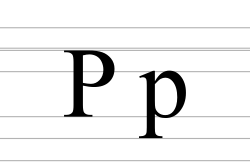
P, or p, is the sixteenth letter of the Latin alphabet, used in the modern English alphabet, the alphabets of other western European languages and others worldwide. Its name in English is pee (pronounced /ˈpiː/ ), plural pees.
| P | |||
|---|---|---|---|
| P p | |||
 | |||
| Usage | |||
| Writing system | Latin script | ||
| Type | Alphabetic and logographic | ||
| Language of origin | Latin language | ||
| Sound values | [p] [pʰ] [(p)f] [pʼ] [b] | ||
| In Unicode | U+0050, U+0070 | ||
| Alphabetical position | 16 | ||
| History | |||
| Development |
| ||
| Time period | c. 700 BCE to present | ||
| Descendants | • Ᵽ • ₱ • ℘ • ⅌ • ℗ • ♇ • ꟼ • ¶ | ||
| Sisters | Π π Ⲡ П ף פ פּ ف ܦ ࠐ 𐎔 በ ጰ ፐ Պ պ प 𐍀 པ | ||
| Other | |||
| Associated graphs | p(x), ph | ||
| Writing direction | Left-to-right | ||


History
The Semitic Pê (mouth), as well as the Greek Π or π (Pi), and the Etruscan and Latin letters that developed from the former alphabet all symbolized /p/, a voiceless bilabial plosive.
| Egyptian | Proto-Sinaitic | Proto-Canaanite pʿit | Phoenician Pe | Western Greek Pi | Etruscan P | Latin P | ||
|---|---|---|---|---|---|---|---|---|
|  |  |  | | | |
Use in writing systems
| Orthography | Phonemes |
|---|---|
| Catalan | /p/ |
| Standard Chinese (Pinyin) | /pʰ/ |
| English | /p/, silent |
| French | /p/, silent |
| German | /p/ |
| Portuguese | /p/ |
| Spanish | /p/ |
| Turkish | /p/ |
English
In English orthography, ⟨p⟩ represents the sound /p/.
A common digraph in English is ⟨ph⟩, which represents the sound /f/, and can be used to transliterate ⟨φ⟩ phi in loanwords from Greek. In German, the digraph ⟨pf⟩ is common, representing a labial affricate /pf/.
Most English words beginning with ⟨p⟩ are of foreign origin, primarily French, Latin and Greek; these languages preserve the Proto-Indo-European initial *p. Native English cognates of such words often start with ⟨f⟩, since English is a Germanic language and thus has undergone Grimm's law; a native English word with an initial /p/ would reflect Proto-Indo-European initial *b, which is so rare that its existence as a phoneme is disputed. However, native English words with non-initial ⟨p⟩ are quite common; such words can come from either Kluge's law or the consonant cluster /sp/ (PIE: *p has been preserved after s).
P is the eighth least frequently used letter in the English language.
Other languages
In most European languages, ⟨p⟩ represents the sound /p/.
Other systems
In the International Phonetic Alphabet, ⟨p⟩ is used to represent the voiceless bilabial plosive.
Other uses
- A bold italic letter p is used in musical notation as a dynamic indicator for "quiet". It stands for the Italian word piano.
Related characters
Ancestors, descendants and siblings
The Latin letter P represents the same sound as the Greek letter Pi, but it looks like the Greek letter Rho.
- 𐤐 : Semitic letter Pe, from which the following symbols originally derive:
- Π π : Greek letter Pi
- 𐌐 : Old Italic and Old Latin P, which derives from Greek Pi, and is the ancestor of modern Latin P. The Roman P had this form (𐌐) on coins and inscriptions until the reign of Claudius, c. 50 AD.
- 𐍀 : Gothic letter pertra/pairþa, which derives from Greek Pi
- П п : Cyrillic letter Pe, which derives from Greek Pi
- Ⲡ ⲡ : Coptic letter Pi
- Պ պ: Armenian letter Pe
- Π π : Greek letter Pi
- P with diacritics: Ṕ ṕ Ṗ ṗ Ᵽ ᵽ Ƥ ƥ ᵱᶈ
- Turned P: P d, an additional letter of the Latin script not encoded in Unicode
- Uralic Phonetic Alphabet-specific symbols related to P:
- U+1D18 ᴘ LATIN LETTER SMALL CAPITAL P
- U+1D3E ᴾ MODIFIER LETTER CAPITAL P
- U+1D56 ᵖ MODIFIER LETTER SMALL P
- p : Subscript small p was used in the Uralic Phonetic Alphabet prior to its formal standardization in 1902
Derived ligatures, abbreviations, signs and symbols
- ₱ : Philippine peso sign
- 𝒫, 𝓅 : script letter P (uppercase and lowercase, respectively), used in mathematics. (In other contexts, a script typeface (or computer font) should be used.)
- ℘ Weierstrass p
- ℗ : sound recording copyright symbol
- ♇ : Pluto symbol, a monogram of the letters "PL", and also the initials of Percival Lowell, heralding his role in its discovery
- ꟼ : Reversed P was used in ancient Roman texts to stand for puella (girl)
- Ꝑ ꝑ, Ꝓ ꝓ, Ꝕ, ꝕ : Various forms of P were used for medieval scribal abbreviations
Other representations
Computing
- U+0050 P LATIN CAPITAL LETTER P
- U+0070 p LATIN SMALL LETTER P
- U+FF30 P FULLWIDTH LATIN CAPITAL LETTER P
- U+FF50 p FULLWIDTH LATIN SMALL LETTER P
Other
| NATO phonetic | Morse code |
| Papa |
| |
| | | |
| Signal flag | Flag semaphore | American manual alphabet (ASL fingerspelling) | British manual alphabet (BSL fingerspelling) | Unified English Braille |
See also
- Mind your Ps and Qs
- Pence or "penny", the English slang for which is p (e.g. "20p" = 20 pence)