
Taiwanese Americans (Chinese: 臺灣裔美國人; pinyin: Táiwān yì měiguó rén; Pe̍h-ōe-jī: Tâi-Bí-jîn) are Americans of Taiwanese ancestry, including American-born descendants of migrants from Taiwan. A 2008 survey by the Taiwanese government placed the Taiwanese American population at approximately 627,000.
Traditional Chinese: 臺灣裔美國人 Pe̍h-ōe-jī: Tâi-Bí-jîn | |
|---|---|
  | |
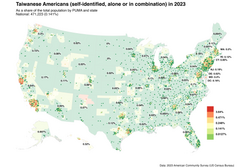 Americans with Taiwanese ancestry by PUMA and state | |
| Total population | |
| 331,224 (2023) (by ancestry or ethnic origin) 392,012 (2023) (born in Taiwan) Range: 195,000 – 900,595 0.06%–0.3% of the U.S. population (2017) | |
| Regions with significant populations | |
| Los Angeles metropolitan area, New York City metropolitan area, San Francisco Bay Area, Greater Boston, Philadelphia metropolitan area, Baltimore–Washington metropolitan area, Seattle metropolitan area, Chicago metropolitan area, Greater Houston, Miami metropolitan area, Las Vegas Valley. | |
| Languages | |
| English, Taiwanese Mandarin, Taiwanese Hokkien, Taiwanese Hakka, Formosan languages | |
| Religion | |
| Christianity, Taiwanese folk (Confucianism, Taoism, Buddhism) | |
| Related ethnic groups | |
| Overseas Taiwanese, Chinese Americans |
Taiwanese Americans are the highest-earning American ethnic group by per capita income and have the highest educational attainment of any ethnic group in the United States. After World War II and the Chinese Civil War, immigrants from Taiwan first began to arrive in the United States, where Taiwanese immigration was shaped by the Hart-Celler Act (1965) and the Taiwan Relations Act (1979). As of the 2010 U.S. Census, 49% of Taiwanese Americans lived in either California, New York, or Texas.
Notable Taiwanese Americans include billionaire CEOs Jensen Huang (Nvidia), Lisa Su (AMD), and Morris Chang (TSMC); entrepreneurs Jerry Yang (co-founder of Yahoo), Steve Chen (co-founder of YouTube), Tony Hsieh (Zappos); politicians Michelle Wu, Andrew Yang, Lanhee Chen, and Elaine Chao; jurists Goodwin Liu, Florence Pan, and James Ho; HIV/AIDS researcher David Ho, chemist David R. Liu, and Nobel Prize laureates Samuel C. C. Ting and Yuan T. Lee. Taiwanese American celebrities include NBA basketball player Jeremy Lin, singer-songwriter Wang Leehom, and actress Constance Wu.
Terminology
Taiwanese Americans are one of the newest Asian American ethnic groups in the United States. They encompass immigrants to the U.S. from the Republic of China (known as Taiwan), which is primarily located on the island of Formosa, and their American-born descendants. The country consists mostly of Chinese descendants from the provinces of Fujian and Guangdong and their Fujianese and Hakka subgroups (benshengren). As a result, the culture of Taiwan also shares many commonalities with Chinese culture which has often led to the categorization of Taiwanese Americans with Chinese Americans. Taiwanese immigrants, prior to 1982, were listed in the "China-born population" category in the United States census.
Together, immigrants from Taiwan, Hong Kong, and China constitute the three largest groups which form the Chinese American population, each with unique socioeconomic, cultural, and historical backgrounds. The term "Taiwanese American" may be considered a subgroup of "Chinese American", though multiple Taiwanese ethnic groups—i.e., Taiwanese indigenous peoples or Fujianese descendants from Zhangzhou or Quanzhou—distinguish themselves from mainland China, and the experience of Taiwanese immigrants differ from that of other Chinese immigrant groups.
The identity of being Taiwanese among both immigrants and descendants in the U.S. has multiple dimensions and has changed over time. Since the leaders, social elites, and affiliates of the nationalist Republic of China (1912–1949), under its Kuomintang government, moved to Taiwan in 1949, Taiwanese Americans also include these mainland Chinese migrants (known as waishengren). The group is more closely associated with China and may also identify as Chinese immigrants or Chinese Americans. However, Taiwanese Americans who consider Taiwan to be independent from China favor a separate political and cultural identity and have lobbied to be counted as a distinct population in the United States census.
History
The first Taiwanese immigrants to the United States arrived in the late 19th century, but significant immigration from the island to the U.S. only began in the mid-20th century, when Taiwanese migrants traveled to the U.S. in search of educational opportunities either on the West Coast or East Coast, particularly in scientific fields. After the end of World War II, the Communist victory in the Chinese Civil War forced the nationalist Kuomintang government to retreat to Taiwan in 1949. American aid to Taiwan in the wake of the Korean War (1950–1953) supported the Kuomintang government and culminated in the 1954 Mutual Defense Treaty between the United States and the Republic of China, which precipitated a small influx of Taiwanese immigrants to come to the United States.
From 1949 up until 1979, the United States recognized the Kuomintang-led ROC as the sole legitimate government of China. As a result, immigration from Taiwan was counted under within the same quota for both mainland China and Taiwan. However, because the People's Republic of China (PRC) banned emigration to the United States until 1977, the quota for immigrants from China was almost exclusively filled by immigrants from Taiwan. In 1979, the United States broke diplomatic relations with the ROC, while the Taiwan Relations Act gave Taiwan a separate immigration quota from that of the PRC.
Before the late 1960s, immigrants from Taiwan to the United States tended to be "mainland Chinese" who had immigrated to Taiwan with the Kuomintang (KMT) after the Chinese Civil War. Later immigrants tended to increasingly be Taiwanese benshengren, or Han Taiwanese whose ancestors had already lived in Taiwan before 1949. Taiwanese immigration to the United States began to subside in the early-1980s due to improving economic and political conditions in Taiwan.
A wave of Taiwanese investment in the 2020s especially around the TSMC Arizona megaproject brought with it a surge of Taiwanese moving to the US for temporary or permanent work in support of these projects. In 2024 a record 137,000 Taiwanese went overseas to work in the United States.
Socioeconomics
Education
One Taiwanese American mother explained in a recent study, “the child’s personal academic achievement is the value and honor of the whole family....If you do good, you bring honor to the family and [do] not lose face. A lot of value is placed on the child to do well for the family. It starts from kindergarten.”
When asked open-endedly in a recent study what makes children do well in school, almost a third of Taiwanese American mothers—compared with zero white American mothers—brought up family honor.
Taiwanese Americans are the most educated ethnic group in the United States. Both Taiwanese immigrant men and women in the U.S. consist primarily of professionals with high income and high educational attainment. Largely influenced by traditional Confucian beliefs widespread in Taiwan, Taiwanese American culture places great emphasis on education. According to a 2000 survey, children's education was considered by Taiwanese couples as a family's most important decision.
The main focus of the Taiwanese American family is the achievement of the highest level of education for children, who "are encouraged to study hard and attempt to attend outstanding universities and graduate schools". In addition to supporting extracurricular activities, Taiwanese American parents "support the development of musical skills over athletic skills [and support] engagement in social causes," with a large portion choosing to enroll their children in Chinese language schools that teach Chinese culture, history, martial arts, and Standard Chinese as opposed to Southern Min dialects such as Taiwanese Hokkien. Parents devote and invest themselves financially in youth education, especially for boys; a child's academic achievements are considered as collective achievements for the family as a whole.
In 2010, 73.7 percent of Taiwanese Americans had earned a bachelor's degree or higher, a percentage significantly higher compared to the American average of 17.6 percent. In the 2013 American Community Survey, over 94 percent of Taiwanese Americans had at least a high school degree or higher. As of 2018, in the Chicago metropolitan area, where more than 80 percent of the Taiwanese American population in the Midwestern United States resides, 97 percent of Taiwanese Americans aged 25 years or older had at least a high school diploma and 84 percent had gone on to earn a bachelor's degree or higher—the highest educational attainment of all other ethnic groups in the area. In 1990, 62 percent of immigrants from Taiwan to the U.S. completed at least four years of college, compared to 46 percent of Hong Kong Americans, 31 percent of immigrants from China, and 21 percent of non-Hispanic whites aged 25 to 64.
| Ethnicity | Bachelor's degree or higher | High school graduate or higher |
|---|---|---|
| Taiwanese | 78.8% | 95.7% |
| Indian | 75.7% | 92.7% |
| Pakistani | 59.8% | 89.4% |
| Korean | 58.9% | 93.3% |
| Chinese average | 56.7% | 84.1% |
| Vietnamese | 55.8% | 92.3% |
| Asian average | 55.6% | 87.8% |
| Japanese | 53.7% | 96.1% |
| Filipino | 49.8% | 93.5% |
| Non-Hispanic White | 34.4% | 90.4% |
| General US Population | 33.1% | 88.6% |
Employment and income
| Ethnicity | Avg income per capita |
|---|---|
| As of 2023 | |
| Taiwanese | $83,811 |
| Indian | $72,389 |
| Japanese | $61,568 |
| Chinese except Taiwanese | $61,289 |
| Filipino | $47,819 |
| Vietnamese | $40,037 |
| Korean | $58,560 |
| U.S. Population average | $43,313 |
Taiwanese Americans are the highest-earning ethnic group in the United States by per capita income and are one of the highest-earning American ethnic groups by household income. In 2010, approximately two-thirds of the adult employed Taiwanese American population worked as white-collar professionals and managers who were highly educated.
Many Taiwanese Americans are highly educated, salaried professionals whose work is largely self-directed in management, professional and related occupations such as engineering, medicine, investment banking, law, and academia. 66.2% of Taiwanese Americans work in many white collar professions compared to 35.9% for the general American population and 48.1% for Asian Americans. 71.3% of Taiwanese men and 60.4% of Taiwanese women work in management, professional, and related occupations. They also hold some of the lowest unemployment rates in the nation with a figure of 4.3% compared to a national rate of 6.9%. The unemployment rate among Taiwanese Americans is generally low at roughly 5 percent.
According to the 2009 U.S. census, Taiwanese American men had one of "the highest year-round, full-time median earnings" with a figure of $76,587, while Taiwanese American women had a median income of $51,307. Taiwanese Americans have one of the lowest poverty rates in the US, with a poverty rate of 9.5% compared to 11.3% for the general American population. Taiwanese immigrant men in 1999 earned an average annual income of $60,367 (equivalent to $116,670 in 2025), the highest of any foreign-born men in the U.S. at the time, and Taiwanese immigrant women earned $40,276 (equivalent to $77,841 in 2025) per year, roughly $10,000 more than the average for other foreign-born U.S. women at the time.
Settlement
The majority of Taiwanese American communities were formed after 1965, following the Immigration and Nationality Act of 1965, and they have since experienced rapid growth. From 2000 to 2010, the Taiwanese American population increased 59 percent from 144,795 (2000) to 230,382 (2010). In 2013, 59 percent of Taiwanese Americans were between age 18 and age 64, 19 percent were from ages <1 to 17, and 9 percent were over the age of 65. The overall median age was 35. 68 percent of Taiwanese Americans in 2013 were born outside of the United States, of which 67 percent became naturalized U.S. citizens.
Immigration to the United States from Taiwan has remained substantial. 42,182 immigrant visas were issued to Taiwan from 2001 to 2010, and among those who received legal permanent residency in 2010, 2,090 (40%) were the immediate relatives of U.S. citizens.
In the late 1970s and early 1980s, Taiwanese emigrants were instrumental in the development of Monterey Park, California in Los Angeles – resulting in the moniker of "Little Taipei" – as well as Flushing, Queens, which generally reflected new investments and capital flowing from Taiwan into newer Taiwanese enclaves instead of traditional Chinatowns. Taiwanese Americans have also brought with them Taiwanese cuisine to the communities they have settled, which, possibly excluding bubble tea, is not generally well known or served outside these aforementioned Taiwanese immigrant enclaves.
While Monterey Park is no longer the largest Taiwanese community in Los Angeles today, Flushing remains the main Taiwanese cultural, commercial, and political center in New York City. In Los Angeles County, California, newer communities such as Rowland Heights, Hacienda Heights, Arcadia, San Marino, Diamond Bar, Walnut, San Gabriel, Temple City, are similar to "Little Taipei." However, many annual Taiwanese cultural events (especially during Taiwanese Heritage Week) are still held in Monterey Park. As an attempt to duplicate the Taiwanese success of Monterey Park in Houston, Texas, Taiwanese immigrant entrepreneurs established what is now widely considered as Houston's new Chinatown on Bellaire Boulevard in the mid-1980s.
The prestige and performance of particular school districts, as well as access to careers in high-tech firms, have played a significant part in influencing the settlement patterns of Taiwanese Americans. Areas with high concentrations of Taiwanese immigrants include the San Gabriel Valley (Greater Los Angeles), Santa Clara Valley (Cupertino, San Jose), East Bay (Dublin, Pleasanton, El Cerrito, Oakland), Los Angeles/Orange County border communities (Cerritos/Artesia), and Irvine in Central Orange County. Outside of California, there are also major Taiwanese concentrations in Flushing, Long Island City, and Forest Hills, all within Queens; Nassau County on Long Island; Jersey City and Hoboken in nearby New Jersey; Rockville, Maryland (northwest of Washington, D.C.); Sugar Land, Texas (near Houston), Plano, Texas (near Dallas); Bellevue, Washington (and adjacent areas) (part of the Greater Seattle Area's "Eastside" communities) and Chandler, Arizona. Additionally, the northeastern suburbs of the Atlanta, Georgia area has also received a significant influx of Taiwanese immigrant residents.
From the middle of the 1980s to the 1990s, large numbers of affluent Taiwanese Americans began moving out to upscale neighborhoods such as Cupertino, San Mateo, Palo Alto, Fremont, Newark, and Pleasanton in the Bay Area; San Marino, Arcadia, South Pasadena, and Temple City in Western San Gabriel Valley; Hacienda Heights, Rowland Heights, Walnut, and Diamond Bar in Eastern San Gabriel Valley; with immigrants from the People's Republic of China and Cantonese and Teochew (mostly from Vietnam) taking their place in Monterey Park, as well as Alhambra. Starting in the 2000s, highly educated Nassau County on Long Island east of New York City, as well as suburbs in northern and central New Jersey, have received a large influx of Taiwanese immigrants.
U.S. metropolitan areas with large Taiwanese American populations
| Rank | Metro Area | Region | Taiwanese-Americans Alone or in Combination (2020 Census) |
|---|---|---|---|
| 1 | Los Angeles Metropolitan Area | Pacific | 66,531 |
| 2 | San Francisco Bay Area | Pacific | 37,281 |
| 3 | New York Metropolitan Area | Mid-Atlantic | 25,189 |
| 4 | Seattle Metropolitan Area | Pacific | 11,509 |
| 5 | Washington Metropolitan Area | South Atlantic | 8,187 |
| 6 | Greater Houston | West South Central | 8,157 |
| 7 | Inland Empire (Riverside-San Bernardino-Ontario) | Pacific | 6,923 |
| 8 | Dallas-Fort Worth Metroplex | West South Central | 6,297 |
| 9 | Greater Boston | New England | 5,950 |
| 10 | San Diego County | Pacific | 5,754 |
| 11 | Chicago Metropolitan Area | East North Central | 5,429 |
Organizations
The influx of Taiwanese immigrants during the 20th century contributed towards the establishment of multiple immigrant organizations which sponsored local meetings, cultural events, and conferences. The Taiwanese American Association, founded in the 1970s, was among the first organizations to provide a nationwide network of active local Taiwanese chapters in urban areas. Multiple early Taiwanese American organizations were dedicated to the Taiwanese independence movement and to advocacy of democratic reform, such as the Formosan Association for Public Affairs (FAPA), which is based in Washington D.C., and the Formosa Foundation, both of which were established with the aim of supporting Taiwanese political interests and to support the international recognition of Taiwan.
Other early organizations founded by Taiwanese Americans supported specific economic, cultural, or political interests, including the North American Taiwanese Professors Association (NATPA) founded in 1982, the North American Taiwanese Medical Association (NATMA) founded in 1984, the Taiwanese Americans Citizens' League founded in 1985 (which has lobbied to count Taiwanese Americans as separate from Chinese Americans), and the North American Taiwanese Women's Association (NATWA) founded in 1988.
Organizations founded by, and dedicated to, second-generation Taiwanese Americans include Taiwanese American Professionals (TAP), the Intercollegiate Taiwanese American Students Association (ITASA), and the Junior Taiwanese American Student Association (JTASA), a high school student network. Universities that all house a student association dedicated to Taiwanese Americans include Harvard University,Princeton University, Yale University, Cornell University, Brown University, Johns Hopkins University, New York University, and the University of California, Berkeley. In addition, cities such as San Jose, California; Rosemead, California; San Diego, California; Seattle, Washington; Flushing, New York; and Houston, Texas, have "Taiwan Centers" which host Taiwanese cultural and recreational activities and sponsor programs for youth and seniors.
In 1986, Chaotian Temple from Taiwan has also established a branch temple known as Ma-Tsu Temple in San Francisco Chinatown with the support of Taiwanese American community.
Media
Taiwanese Americans also run several of North America's major Chinese-language newspapers, such as the World Journal based in Queens; and the Chicago Chinese News. However, these influential and highly circulated newspapers are not geared solely to Taiwanese immigrants, but also serve a broader Chinese-speaking immigrant readership. Pacific Journal is a weekly Taiwanese-run newspaper that is geared more exclusively toward Taiwanese readers.
Due to the significant Taiwanese American community, Taiwanese media dominates the Chinese-language airwaves in the United States. Cable and satellite television of Taiwan-based media keeps Taiwanese Americans abreast of news developments and programming in Taiwan. For example, satellite stations ETTV America and CTI cater to Mandarin-speaking Taiwanese immigrants.
Taiwanese nationality and residency


In the 1960s, many Taiwanese Americans chose to make America their permanent home and had children in the U.S. Most sought refuge from the numerous arrests and executions during the White Terror era of the KMT, the political party which had dictatorially ruled the country. By the late 1970s, improving economic conditions in Taiwan slowed the rate of immigration. During the 1990s, political liberalization in Taiwan encouraged many who had left Taiwan to return.
Although the oath of naturalization of the United States contains a statement renouncing "allegiance and fidelity" to other countries, the Republic of China (the formal name of Taiwan) does not recognize this renunciation as sufficient for the termination of ROC nationality, and requires a person who wishes to renounce ROC nationality to take another oath before an ROC consular officer. All renunciations are subject to approval from the Ministry of the Interior, and the Ministry may deny a person's application under Taiwanese law. Without formal renunciation, the ROC government considers its emigrants with American citizenship to continue to be nationals of the ROC. Acquiring US citizenship has no effect on the holder's status as a national of ROC, which makes Taiwan-born Americans still eligible to vote in the ROC elections, provided that their household registration is still intact in Taiwan.

Unlike their Taiwan-born parents, the American-born second generation do not have household registration in Taiwan at birth, making them nationals without household registration (NWOHRs), despite the fact that they are also ROC nationals under Taiwanese law. In contrast with those with household registration in Taiwan, NWOHRs cannot receive a Taiwanese National Identification Card, do not have right of abode in Taiwan, and are subject to immigration control while in Taiwan. They are, however, eligible for a Taiwan passport. It is possible for NWOHRs to be registered as nationals with household registration (NWHRs) if they meet the requirements listed under the Immigration Act of Taiwan.
Connection to politics of Taiwan and cultural ties
Many Taiwanese Americans play an active role in the politics and culture of Taiwan, aided in large part by recognition of dual citizenship. According to The New York Times, Taiwanese Americans are "some of the most determined voters in the world" and several thousand travel back to Taiwan to vote in Taiwanese elections.
The identity politics of Taiwan also influences at least first generation Taiwanese Americans. Many government officials, including presidents Lai Ching-te, Tsai Ing-wen, Ma Ying-jeou, and Lee Teng-hui, have received graduate degrees in the United States. The United States was also a major destination for anti-KMT figures such as Peng Ming-min and Chai Trong-rong, where they were politically exiled. Others, including Nobel Prize laureate Yuan T. Lee were educated in the United States.
Cuisine
Taiwanese immigrant restaurateurs were largely responsible for the shift of American Chinese food from Cantonese-focused cuisine to diverse cuisine featuring dishes from many regions in China. The immigration of Taiwanese chefs to the United States began in the 1950s. At the time, cooks in Taiwan were trained in traditional Chinese regional cooking as this fit the chosen identity of the KMT. Taiwanese restaurateurs changed the food landscape of many American cities, including New York City, and pioneered innovations such as picture menus and food delivery. Many of the immigrants to the United States during this period had been born in China and fled to Taiwan with the retreating KMT, particularly former residents of the Dachen Islands who had been evacuated in 1955.
Traditionally, Taiwanese food has been hard to differentiate from Chinese and Japanese food abroad, since many Taiwanese chefs cooked simplified or westernized versions of traditional Taiwanese, Japanese, or Chinese dishes. In 2018, there was a rapid growth in the number of authentic Taiwanese restaurants in New York City and across the country, which coincided with an increased interest in regional Chinese food and in Taiwan itself. Some object to the politically fraught inclusion of Taiwanese cuisine under the banner of regional Chinese food and point out that it is inaccurate.
Taiwanese American cuisine is emerging as a full cuisine in its own right. Myers + Chang in Boston was one of the first restaurants to explicitly describe their food as such. In 2018, James Beard Award-winning chef Stephanie Izard opened a Taiwanese snack/dessert shop in Chicago. Taiwanese cuisine has a significant presence in the San Francisco Bay Area. Most Taiwanese restaurants in the Bay Area are located in the suburbs. Increasing interest in authentic Taiwanese food is coming from ex-pats and second generation Taiwanese Americans.
Kato by Chef Jon Yao is a Michelin-starred restaurant serving Taiwanese food in Los Angeles.
Cookbooks
A Taiwanese American cookbook, First Generation, was published by Frankie Gaw in 2022. The book contains recipes from Gaw's childhood growing up in the American midwest.
In 2023, Cathy Erway published Win Son Presents: A Taiwanese American Cookbook in collaboration with Josh Ku and Trigg Brown.
Notable Taiwanese Americans

吳弭
楊安澤
劉弘威
陳仁宜
邱信福
劉雲平
| Name | Birthdate | Notability |
|---|---|---|
| Michelle Wu | 1985 | Mayor of Boston (D‑MA) |
| Elaine Chao | 1953‡ | 18th U.S. Secretary of Transportation (R‑NY) |
| Andrew Yang | 1975 | Co-Chair of the Forward Party |
| David Wu | 1955‡ | U.S. Representative for Oregon (D‑OR) |
| Lanhee Chen | 1978 | Member of Amtrak and Social Security Board (R‑CA) |
| Katherine Tai | 1974 | 19th United States Trade Representative (D‑CT) |
| Ted Lieu | 1969 | U.S. Representative from California (D‑CA) |
| David Chiu | 1970‡ | City Attorney of San Francisco (D‑CA) |
| Grace Meng | 1975 | U.S. Representative from New York (D‑NY) |
| Chris Lu | 1966 | U.S. Deputy Secretary of Labor (D‑NJ) |
| Goodwin Liu | 1970 | Justice of the California Supreme Court |
| Florence Y. Pan | 1966 | Judge of the Court of Appeals for the D.C. Circuit |
| James C. Ho | 1973‡ | Judge of the Court of Appeals for the Fifth Circuit |
| Julie Su | 1969 | Acting U.S. Secretary of Labor (D‑WI) |
| Portia Wu | 1970 | Secretary of the Maryland Department of Labor |
| Hsiao Bi-khim | 1971 | 13th Vice President of the Republic of China |
| Cynthia Wu | 1978 | Member of the Legislative Yuan |
| ‡ Born in Taiwan | ||
林書豪
吳恬敏
王力宏
姜峯楠
陳海翔
游朝凱
| Name | Birthdate | Notability |
|---|---|---|
| Yuan T. Lee | 1936 | Awarded Nobel Prize in Chemistry (1986) |
| Samuel C. C. Ting | 1936 | Awarded Nobel Prize for Physics (1976) |
| David R. Liu | 1973 | Harvard University, Broad Institute professor |
| Tim Wu | 1971 | Columbia Law School professor and scholar |
| Ed Lu | 1963 | Physicist and NASA astronaut |
| Kai-Fu Lee | 1961‡ | Apple, Google, and Microsoft scientist |
| Thomas Huang | 1936–2020‡ | Computer scientist at University of Illinois |
| David Ho | 1952‡ | Virologist, pioneer of HIV/AIDS research |
| Fan Chung | 1949‡ | Mathematician at UC San Diego |
| Chang-Lin Tien | 1935–2002‡ | Chancellor of UC Berkeley |
| Paul Ching Wu Chu | 1949‡ | President of HKUST |
| Yuan Chang | 1959‡ | Pathologist, discovered MCPyV and KSHV |
| Chenming Hu | 1947‡ | Engineering professor at UC Berkeley |
| Andrew Yao | 1946 | Computer scientist, computational theorist |
| Henry Yang | 1940‡ | Chancellor of UC Santa Barbara |
| James C. Liao | 1958‡ | President of Academia Sinica |
| Lan Samantha Chang | 1965 | Endowed professor, University of Iowa |
| ‡ Born in Taiwan or Republic of China (1912–1949) | ||
| Name | Birthdate | Notability |
|---|---|---|
| Jensen Huang | 1963‡ | Co-founder, CEO, and president of Nvidia |
| Lisa Su | 1969‡ | CEO, president, and chair of AMD |
| Morris Chang | 1931‡ | Founder, CEO, and chairman of TSMC |
| Jeremy Lin | 1988 | Basketball player at Harvard, New York Knicks |
| Jerry Yang | 1968‡ | Co-founder and CEO of Yahoo |
| Steve Chen | 1978‡ | Co-founder of YouTube |
| Constance Wu | 1982 | Actress known for Crazy Rich Asians (2018) |
| Wang Leehom | 1976 | Singer-songwriter, actor, producer |
| Janet Hsieh | 1980 | Model, violinist, television personality |
| Ted Chiang | 1967 | Science fiction writer |
| Emily Chang | 1980 | Journalist, television host, reporter, author |
| Tao Lin | 1983 | Novelist, poet, essayist, short-story writer, and artist |
| Charles Yu | 1976 | Writer known for Interior Chinatown (2020) |
| Tony Hsieh | 1973–2020 | Founder and CEO of Zappos |
| Ellen Pao | 1970 | CEO of Reddit |
| Greg Tseng | 1979‡ | Founder and CEO of Tagged |
| Alexander Massialas | 1994 | Fencer and Olympic medalist from Stanford |
| Dan Lin | 1973‡ | TV producer, executive at Warner Bros. Pictures |
| Andy Fang | 1992 | Co-founder and CTO of DoorDash |
| Justin Lin | 1971 | Film and television director, producer, and screenwriter. |
| ‡ Born in Taiwan or Republic of China (1912–1949) | ||
See also

- List of Taiwanese Americans
- Taiwanese people
- Han Taiwanese
- Hoklo Americans
- Hakka Americans
- Taiwan-United States relations
- Taiwanese Americans in the San Francisco Bay Area
- Taiwanese people in New York City
- Taiwanese Americans in Los Angeles