
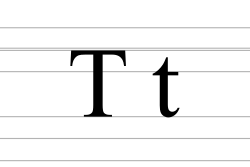
T, or t, is the twentieth letter of the Latin alphabet, used in the modern English alphabet, the alphabets of other western European languages and others worldwide. Its name in English is tee (pronounced /ˈtiː/ ), plural tees.
| T | |||
|---|---|---|---|
| T t | |||
 | |||
| Usage | |||
| Writing system | Latin script | ||
| Type | Alphabetic and logographic | ||
| Language of origin | Latin language | ||
| Sound values |
| ||
| In Unicode | U+0054, U+0074 | ||
| Alphabetical position | 20 | ||
| History | |||
| Development |
| ||
| Time period | c. 700 BCE to present | ||
| Descendants |
| ||
| Sisters |
| ||
| Other | |||
| Associated graphs | t(x), th, tzsch | ||
| Writing direction | Left-to-right | ||


It is derived from the Semitic Taw 𐤕 of the Phoenician and Paleo-Hebrew script (Aramaic and Hebrew Taw ת/𐡕/ , Syriac Taw ܬ, and Arabic ت Tāʼ) via the Greek letter τ (tau). In English, it is most commonly used to represent the voiceless alveolar plosive, a sound it also denotes in the International Phonetic Alphabet. It is the most commonly used consonant and the second-most commonly used letter in English-language texts.
History
| Phoenician Taw | Western Greek Tau | Etruscan T | Latin T |
|---|---|---|---|
 | | | |
Taw was the last letter of the Western Semitic and Hebrew alphabets. The sound value of Semitic Taw, the Greek alphabet Tαυ (Tau), Old Italic and Latin T has remained fairly constant, representing [t] in each of these, and it has also kept its original basic shape in most of these alphabets.
Use in writing systems
| Orthography | Phonemes |
|---|---|
| Catalan | /t/ |
| Standard Chinese (Pinyin) | /tʰ/ |
| English | /t/, silent |
| French | /t/, silent |
| German | /t/ |
| Icelandic | /tʰ/ |
| Indonesian | /t/ |
| Portuguese | /t/ |
| [t͡ʃ], allophone of /t/ before /i/, /ĩ/ and /j/ in some Brazilian dialects | |
| Spanish | /t/ |
| Turkish | /t/ |
English
In English, ⟨t⟩ usually denotes the voiceless alveolar plosive (International Phonetic Alphabet: /t/), as in tart, tee, or ties, often with aspiration at the beginnings of words or before stressed vowels. The letter ⟨t⟩ corresponds to the affricate /t͡ʃ/ in some words as a result of yod-coalescence (for example, in words ending in -"ture", such as future).
A common digraph is ⟨th⟩, which usually represents a dental fricative, but occasionally represents /t/ (as in Thomas and thyme). The digraph ⟨ti⟩ often corresponds to the sound /ʃ/ (a voiceless palato-alveolar sibilant) word-medially when followed by a vowel, as in nation, ratio, negotiation, and Croatia.
In a few words of modern French origin, the letter T is silent at the end of a word; these include croquet and debut.
Other languages
In the orthographies of other languages, ⟨t⟩ is often used for /t/, the voiceless dental plosive /t̪/, or similar sounds.
Other systems
In the International Phonetic Alphabet, ⟨t⟩ denotes the voiceless alveolar plosive.
Other uses
- Unit prefix T, meaning 1,000,000,000,000 times.
Related characters
Descendants and related characters in the Latin alphabet
- T with diacritics: Ť ť Ṫ ṫ ẗ Ţ ţ Ṭ ṭ Ʈ ʈ Ț ț ƫ Ṱ ṱ Ṯ ṯ Ŧ ŧ Ⱦ ⱦ Ƭ ƭ ᵵᶵ
- Ꞇ ꞇ : Insular T, also used by William Pryce to designate the voiceless dental fricative [θ]
- ᫎ : Combining small insular t was used in the Ormulum
- ʇ : Turned small t is used in the International Phonetic Alphabet (IPA)
- 𐞯 : Modifier letter small t with retroflex hook is a superscript IPA letter
- 𝼉 : Latin small letter t with hook and retroflex hook is a symbol for a voiceless retroflex implosive
- 𝼍 : Latin small turned t with curl is a click letter
- Uralic Phonetic Alphabet-specific symbols related to T:
- U+1D1B ᴛ LATIN LETTER SMALL CAPITAL T
- U+1D40 ᵀ MODIFIER LETTER CAPITAL T
- U+1D57 ᵗ MODIFIER LETTER SMALL T
- U+1E97 ẗ LATIN SMALL LETTER T WITH DIAERESIS
- ₜ : Subscript small t was used in the Uralic Phonetic Alphabet prior to its formal standardization in 1902
- ȶ : T with curl is used in Sino-Tibetanist linguistics
- Ʇ ʇ : Turned capital T and turned small t were used in transcriptions of the Dakota language in publications of the American Board of Ethnology in the late 19th century.
- 𝼪 : Small t with mid-height left hook was used by the British and Foreign Bible Society in the early 20th century for romanization of the Malayalam language.
Ancestors and siblings in other alphabets
- 𐤕 : Semitic letter Taw, from which the following symbols originally derive:
- Τ τ : Greek letter Tau
- Ⲧ ⲧ : Coptic letter Taw, which derives from Greek Tau
- Т т : Cyrillic letter Te, also derived from Tau
- 𐍄 : Gothic letter tius, which derives from Greek Tau
- 𐌕 : Old Italic T, which derives from Greek Tau, and is the ancestor of modern Latin T
- ᛏ : Runic letter teiwaz, which probably derives from old Italic T
- Τ τ : Greek letter Tau
- ፐ : One of the 26 consonantal letters of the Ge'ez script. The Ge'ez abugida developed under the influence of Christian scripture by adding obligatory vocalic diacritics to the consonantal letters. Pesa ፐ is based on Tawe ተ.
Derived signs, symbols and abbreviations
- ™ : Trademark symbol
- ₮ : Mongolian tögrög
- ₸ : Kazakhstani tenge
- ৳ : Bangladeshi taka
Other representations
Computing
Unicode:
- U+0054 T LATIN CAPITAL LETTER T
- U+0074 t LATIN SMALL LETTER T
- U+FF34 T FULLWIDTH LATIN CAPITAL LETTER T
- U+FF54 t FULLWIDTH LATIN SMALL LETTER T
Codepoints 005416 (8410) and x007416 (11610) were used for encodings based on ASCII, including the DOS, Windows, ISO-8859 and Macintosh families of encodings.
Other
| NATO phonetic | Morse code |
| Tango |
| |
| | | |
| Signal flag | Flag semaphore | American manual alphabet (ASL fingerspelling) | British manual alphabet (BSL fingerspelling) | Braille dots-2345 Unified English Braille |
- The letter T in German Sign Language