
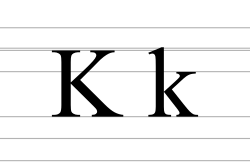
K, or k, is the eleventh letter of the Latin alphabet, used in the modern English alphabet, the alphabets of other western European languages and others worldwide. Its name in English is kay (pronounced /ˈkeɪ/ ), plural kays.
| K | |||
|---|---|---|---|
| K k | |||
 | |||
| Usage | |||
| Writing system | Latin script | ||
| Type | Alphabetic and Logographic | ||
| Language of origin | Latin language | ||
| Sound values |
| ||
| In Unicode | U+004B, U+006B | ||
| Alphabetical position | 11 | ||
| History | |||
| Development |
| ||
| Time period | c. 700 BCE to present | ||
| Descendants |
| ||
| Sisters |
| ||
| Other | |||
| Associated graphs | k(x) | ||
| Writing direction | Left-to-right | ||


The letter K usually represents the voiceless velar plosive.
History
| Egyptian hieroglyph D | Proto-Sinaitic K | Proto-Canaanite kap | Phoenician kaph | Western Greek Kappa | Etruscan K | Latin K | ||
|---|---|---|---|---|---|---|---|---|
|  |  |  | | | |
The letter K comes from the Greek letter Κ (kappa), which was taken from the Semitic kaph, the symbol for an open hand. This, in turn, was likely adapted by Semitic tribes who had lived in Egypt from the hieroglyph for "hand" representing /ḏ/ in the Egyptian word for hand, ⟨ḏ-r-t⟩ (likely pronounced /ˈcʼaːɾat/ in Old Egyptian). The Semites evidently assigned it the sound value /k/ instead, because their word for hand started with that sound.
K was brought into the Latin alphabet with the name ka /kaː/ to differentiate it from C, named ce (pronounced /keː/) and Q, named qu and pronounced /kuː/. In the earliest Latin inscriptions, the letters C, K and Q were all used to represent the sounds /k/ and /ɡ/ (which were not differentiated in writing). Of these, Q was used before a rounded vowel (e.g. ⟨EQO⟩ 'ego'), K before /a/ (e.g. ⟨KALENDIS⟩ 'calendis'), and C elsewhere. Later, the use of C and its variant G replaced most usages of K and Q. K survived only in a few fossilized forms, such as Kalendae, "the calends".
After Greek words were taken into Latin, the kappa was transliterated as a C. Loanwords from other alphabets with the sound /k/ were also transliterated with C. Hence, the Romance languages generally use C, in imitating Classical Latin's practice, and have K only in later loanwords from other language groups. The Celtic languages also tended to use C instead of K, and this influence carried over into Old English.
Use in writing systems
| Orthography | Phonemes | Environment |
|---|---|---|
| Standard Chinese (Pinyin) | /kʰ/ | |
| English | /k/, silent | |
| Esperanto | /k/ | |
| Faroese | /k/ | |
| /tʃʰ/ | Before ⟨e⟩ (except ⟨ei⟩), ⟨i⟩, and ⟨j⟩ | |
| German | /k/ | |
| Ancient Greek romanization | /k/ | |
| Modern Greek romanization | /k/ | Except before /e, i/ |
| /c/ | Before /e, i/ | |
| Icelandic | /kʰ/, /cʰ/, /k/, /c/, /ʰk/, /x/ | |
| Norwegian | /k/ | Except before ⟨i⟩ or ⟨y⟩ |
| /ç/ | Before ⟨i⟩ or ⟨y⟩ | |
| Swedish | /k/ | |
| /ɕ/ | Before ⟨e⟩, ⟨i⟩, ⟨y⟩, ⟨y⟩, ⟨ä⟩, ⟨ö⟩ | |
| Turkish | /k/ | Except before ⟨â⟩, ⟨e⟩, ⟨i⟩, ⟨ö⟩, ⟨û⟩, ⟨ü⟩ |
| /c/ | Before ⟨â⟩, ⟨e⟩, ⟨i⟩, ⟨ö⟩, ⟨û⟩, ⟨ü⟩ |
English
The letter usually represents /k/ in English. It is silent when it comes before ⟨n⟩ at the start of a stem, e.g.:
- At the start of a word (knight, knife, knot, know, and knee)
- After a prefix (unknowable)
- In compounds (penknife)
English is now the only Germanic language to productively use "hard" ⟨c⟩ (outside the digraph ⟨ck⟩) rather than ⟨k⟩ (although Dutch uses it in loan words of Latin origin, and the pronunciation of these words follows the same hard/soft distinction as in English).[citation needed]
Like J, X, Q, and Z, the letter K is not used very frequently in English. It is the fifth least frequently used letter in the English language, with a frequency in words of about 0.8%.
Other languages
In most languages where it is employed, this letter represents the sound /k/ (with or without aspiration) or some similar sound.
The Latinization of Modern Greek also uses this letter for /k/. However, before the front vowels (/e, i/), this is rendered as [c], which can be considered a separate phoneme.
Other systems
The International Phonetic Alphabet uses ⟨k⟩ for the voiceless velar plosive.
Other uses
- In the International System of Units (SI), the SI prefix for one thousand is kilo-, officially abbreviated as k: for example, prefixed to metre/meter or its abbreviation m, kilometre or km signifies a thousand metres. As such, people occasionally represent numbers in a non-standard notation by replacing the last three zeros of the general numeral with K, as in 30K for 30,000.
- "K" replacing "C" in satiric misspelling.
- K is the unit symbol for the kelvin, used to measure thermodynamic temperature (the degree sign is not used with this symbol).
- K is the chemical symbol for element potassium (from its Latin name kalium).
- A white K in a blue triangle indicates Triangle K Kosher certification.
- In chess notation, the letter K represents the King (WK for White King, BK for Black King).
- In baseball scoring, the letter K is used to represent a strikeout. A forwards oriented K represents a "strikeout swinging"; a backwards oriented K ( ) represents a "strikeout looking".
- As an abbreviation for OK, often used in emails and short text messages.
- K is used as a slang term for Ketamine among recreational drug users.
- In the CMYK color model, K represents black ink.
- In International Morse code, it is used to mean "over".
- In fracture mechanics, K is used to represent the stress intensity factor.
- In physics, k usually stands for the Boltzmann constant.
- In Argentinian politics, K is used as a symbol for Kirchnerism.
- K (logic).
- In the United Kingdom under the old system (before 2001), a licence plate that begins with "K" for example "K123 XYZ" would correspond to a vehicle registered between August 1, 1992, and July 31, 1993. Again under the old system, a licence plate that ends with "K" for example "ABC 123K" would correspond to a vehicle that was registered between August 1, 1971, and July 31, 1972.
- On Idaho license plates, an initial K in the plate number indicates it was issued in Kootenai County.
Related characters
Ancestors, descendants and siblings
- 𐤊: Semitic letter Kaph, from which the following symbols originally derive:
- Κ κ/ϰ: Greek letter kappa, from which K derives
- К к: Cyrillic letter Ka, also derived from Kappa
- K with diacritics: Ƙ ƙ, Ꝁ ꝁ, Ḱ ḱ, Ǩ ǩ, Ḳ ḳ, Ķ ķ, ᶄ, Ⱪ ⱪ, Ḵ ḵ
- Ꞣ and ꞣ were used in Latvian orthography before 1921
- The Uralic Phonetic Alphabet uses various forms of the letter K:
- U+1D0B ᴋ LATIN LETTER SMALL CAPITAL K
- U+1D37 ᴷ MODIFIER LETTER CAPITAL K
- U+1D4F ᵏ MODIFIER LETTER SMALL K
- ₖ: Subscript small k was used in the Uralic Phonetic Alphabet prior to its formal standardization in 1902.
- Ʞ ʞ: Turned capital and small k were used in transcriptions of the Dakota language in publications of the American Board of Ethnology in the late 19th century. Turned small k was also used for a velar click in the International Phonetic Alphabet but its use was withdrawn in 1970.
- 𝼐: Small capital turned k is used as a click letter
- 𝼃: Small letter reversed k is used as a Voice Quality Symbol (VoQS)
Ligatures and abbreviations
- ₭ : Lao kip
- Ꝃ ꝃ, Ꝅ ꝅ : Various forms of K were used for medieval scribal abbreviations
Other representations
Computing
| Preview | K | k | K | K | k | |||||
|---|---|---|---|---|---|---|---|---|---|---|
| Unicode name | LATIN CAPITAL LETTER K | LATIN SMALL LETTER K | KELVIN SIGN | FULLWIDTH LATIN CAPITAL LETTER K | FULLWIDTH LATIN SMALL LETTER K | |||||
| Encodings | decimal | hex | dec | hex | dec | hex | dec | hex | dec | hex |
| Unicode | 75 | U+004B | 107 | U+006B | 8490 | U+212A | 65323 | U+FF2B | 65355 | U+FF4B |
| UTF-8 | 75 | 4B | 107 | 6B | 226 132 170 | E2 84 AA | 239 188 171 | EF BC AB | 239 189 139 | EF BD 8B |
| Numeric character reference | K | K | k | k | K | K | K | K | k | k |
| EBCDIC family | 210 | D2 | 146 | 92 | ||||||
| ASCII | 75 | 4B | 107 | 6B | ||||||
Other
| NATO phonetic | Morse code |
| Kilo |
| |
| | | |
| Signal flag | Flag semaphore | American manual alphabet (ASL fingerspelling) | British manual alphabet (BSL fingerspelling) | Braille dots-13 Unified English Braille |