
Far-right politics are politics further to the right on the political spectrum than the standard political right. Far-right politics encompass a range of ideologies that are marked by ultraconservatism, authoritarianism, ultranationalism, radical anti-communism, ethnonationalism, and nativism. This political spectrum situates itself on the far end of the right, distinguished from more mainstream right-wing ideologies by its emphasis on postliberalist and exclusivist views or opposition to liberal democracy. Far-right ideologies have historically included reactionary conservatism, fascism, and Nazism, while contemporary manifestations also incorporate neo-fascism, neo-Nazism, supremacism, and various other movements characterized by chauvinism, xenophobia, and theocratic or reactionary beliefs. Far-right terrorism consists of extremist, militant, or insurgent groups that attempt to realise their ideals through political violence rather than using democratic processes.
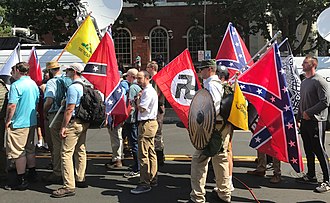
Key to the far-right worldview is the notion of societal purity, often invoking ideas of a homogeneous "national" or "ethnic" community. This view generally promotes organicism, which perceives society as a unified, natural entity under threat from diversity or modern pluralism. Far-right movements frequently target perceived threats to their idealized community, whether ethnic, religious, or cultural, leading to anti-immigrant sentiments, welfare chauvinism, and, in extreme cases, political violence or oppression. According to political theorists, the far right appeals to those who believe in maintaining strict cultural and ethnic divisions and a return to traditional social hierarchies and values.
In practice, far-right movements differ widely by region and historical context. In Western Europe, they have often focused on anti-immigration and anti-globalism, while in Eastern Europe, strong anti-communist rhetoric is more common. The United States has seen a unique evolution of far-right movements that emphasize nativism and radical opposition to an increasingly centralized federal government.
Far-right politics have led to oppression, political violence, forced assimilation, ethnic cleansing, and genocide against groups of people based on their supposed inferiority or their perceived threat to the native ethnic group, nation, state, national religion, dominant culture, or conservative social institutions. Across these contexts, far-right politics has continued to influence discourse, occasionally achieving electoral success and prompting significant debate over its place in democratic societies.
Overview
Concept and worldview
According to scholars Jean-Yves Camus and Nicolas Lebourg, the core of the far right's worldview is organicism, the idea that society functions as a complete, organized and homogeneous living being. Adapted to the community they wish to constitute or reconstitute (whether based on ethnicity, nationality, religion or race), the concept leads them to reject every form of universalism in favor of autophilia and alterophobia, or in other words the idealization of a "we" excluding a "they". The far right tends to absolutize differences between nations, races, individuals or cultures since they disrupt their efforts towards the utopian dream of the "closed" and naturally organized society, perceived as the condition to ensure the rebirth of a community finally reconnected to its quasi-eternal nature and re-established on firm metaphysical foundations.
As they view their community in a state of decay facilitated by the ruling elites, far-right members portray themselves as a natural, sane and alternative elite, with the redemptive mission of saving society from its promised doom. They reject both their national political system and the global geopolitical order (including their institutions and values, e.g. political liberalism and egalitarian humanism) which are presented as needing to be abandoned or purged of their impurities, so that the "redemptive community" can eventually leave the current phase of liminal crisis to usher in the new era. The community itself is idealized through great archetypal figures (the Golden Age, the savior, decadence and global conspiracy theories) as they glorify non-rationalistic and non-materialistic values such as the youth or the cult of the dead.
Political scientist Cas Mudde argues that the far right can be viewed as a combination of four broadly defined concepts, namely exclusivism (e.g. racism, xenophobia, ethnocentrism, ethnopluralism, chauvinism, including welfare chauvinism), anti-democratic and non-individualist traits (e.g. cult of personality, hierarchism, monism, populism, anti-particracy, an organicist view of the state), a traditionalist value system lamenting the disappearance of historic frames of reference (e.g. law and order, the family, the ethnic, linguistic and religious community and nation as well as the natural environment) and a socioeconomic program associating corporatism, state control of certain sectors, agrarianism, and a varying degree of belief in the free play of socially Darwinistic market forces. Mudde then proposes a subdivision of the far-right nebula into moderate and radical leanings, according to their degree of exclusionism and essentialism.
Definition and comparative analysis
The Encyclopedia of Politics: The Left and the Right states that far-right politics include "persons or groups who hold extreme nationalist, xenophobic, homophobic, racist, religious fundamentalist, or other reactionary views." While the term far right is typically applied to fascists and neo-Nazis, it has also been used to refer to those to the right of mainstream right-wing politics.

According to political scientist Lubomír Kopeček, "[t]he best working definition of the contemporary far right may be the four-element combination of nationalism, xenophobia, law and order, and welfare chauvinism proposed for the Western European environment by Cas Mudde." Relying on those concepts, far-right politics includes yet is not limited to aspects of authoritarianism, anti-communism, and nativism. Claims that superior people should have greater rights than inferior people are often associated with the far right, as they have historically favored a social Darwinistic or elitist hierarchy based on the belief in the legitimacy of the rule of a supposedly superior minority over the inferior masses. Regarding the socio-cultural dimension of nationality, culture and migration, one far-right position is the view that certain ethnic, racial, or religious groups should stay separate, based on the belief that the interests of one's own group should be prioritized.
In Western Europe, far-right parties have been associated with anti-immigrant policies, as well as opposition to globalism and European integration. They often make nationalist and xenophobic appeals which make allusions to ethnic nationalism rather than civic nationalism (or liberal nationalism). Some have at their core illiberal policies, such as removing checks on executive authority, and protections for minorities from majority (multipluralism). In the 1990s, the "winning formula" was often to attract anti-immigrant blue collar workers and white collar workers who wanted less state intervention in the economy, but in the 2000s, this switched to welfare chauvinism.
In comparing the Western European and post-Communist Central European far-right, Kopeček writes that "[t]he Central European far right was also typified by a strong anti-Communism, much more markedly than in Western Europe", allowing for "a basic ideological classification within a unified party family, despite the heterogeneity of the far right parties." Kopeček concludes that a comparison of Central European far-right parties with those of Western Europe shows that "these four elements are present in Central Europe as well, though in a somewhat modified form, despite differing political, economic, and social influences." In the American and more general Anglo-Saxon environment, the most common term is "radical right", which has a broader meaning than the European radical right. Mudde defines the American radical right as an "old school of nativism, populism, and hostility to central government [which] was said to have developed into the post-World War II combination of ultranationalism and anti-communism, Christian fundamentalism, militaristic orientation, and anti-alien sentiment."
Jodi Dean argues that "the rise of far-right anti-communism in many parts of the world" should be interpreted "as a politics of fear, which utilizes the disaffection and anger generated by capitalism. [...] Partisans of far right-wing organizations, in turn, use anti-communism to challenge every political current which is not embedded in a clearly exposed nationalist and racist agenda. For them, both the USSR and the European Union, leftist liberals, ecologists, and supranational corporations – all of these may be called 'communist' for the sake of their expediency."
In Hate in the Homeland: The New Global Far Right, Cynthia Miller-Idriss examines the far right as a global movement and representing a cluster of overlapping "antidemocratic, antiegalitarian, white supremacist" beliefs that are "embedded in solutions like authoritarianism, ethnic cleansing or ethnic migration, and the establishment of separate ethno-states or enclaves along racial and ethnic lines".
Modern debates
Terminology

According to Jean-Yves Camus and Nicolas Lebourg, the modern ambiguities in the definition of far-right politics lie in the fact that the concept is generally used by political adversaries to "disqualify and stigmatize all forms of partisan nationalism by reducing them to the historical experiments of Italian Fascism [and] German National Socialism". Mudde agrees and notes that "the term is not only used for scientific purposes but also for political purposes. Several authors define right-wing extremism as a sort of anti-thesis against their own beliefs." While the existence of such a political position is widely accepted among scholars, figures associated with the far-right rarely accept this denomination, preferring terms like "national movement" or "national right". There is also debate about how appropriate the labels neo-fascist or neo-Nazi are. In the words of Mudde, "the labels Neo-Nazi and to a lesser extent neo-Fascism are now used exclusively for parties and groups that explicitly state a desire to restore the Third Reich or quote historical National Socialism as their ideological influence."
According to Léonie de Jonge the term "far right", as used generally among political scientists, is an umbrella term which encompasses the theoretically distinct "radical right" and "extreme right". One issue is whether parties should be labelled radical or extreme, a distinction that is made by the Federal Constitutional Court of Germany when determining whether or not a party should be banned. Within the broader family of the far right, the extreme right is revolutionary, opposing popular sovereignty and majority rule, and sometimes supporting violence, whereas the radical right is reformist, accepting free elections, but opposing fundamental elements of liberal democracy such as minority rights, rule of law, or separation of powers.
After a survey of the academic literature, Mudde concluded in 2002 that the terms "right-wing extremism", "right-wing populism", "national populism", or "neo-populism" were often used as synonyms by scholars (or, nonetheless, terms with "striking similarities"), except notably among a few authors studying the extremist-theoretical tradition.
Relation to right-wing politics
Italian philosopher and political scientist Norberto Bobbio argues that attitudes towards equality are primarily what distinguish left-wing politics from right-wing politics on the political spectrum: "the left considers the key inequalities between people to be artificial and negative, which should be overcome by an active state, whereas the right believes that inequalities between people are natural and positive, and should be either defended or left alone by the state."
Aspects of far-right ideology can be identified in the agenda of some contemporary right-wing parties: in particular, the idea that superior persons should dominate society while undesirable elements should be purged, which in extreme cases has resulted in genocides. Charles Grant, director of the Centre for European Reform in London, distinguishes between fascism and right-wing nationalist parties which are often described as far right such as the National Front in France. Mudde notes that the most successful European far-right parties in 2019 were "former mainstream right-wing parties that have turned into populist radical right ones." According to historian Mark Sedgwick, "[t]here is no general agreement as to where the mainstream ends and the extreme starts, and if there ever had been agreement on this, the recent shift in the mainstream would challenge it."
Proponents of the horseshoe theory interpretation of the left–right political spectrum identify the far left and the far right as having more in common with each other as extremists than each of them has with centrists or moderates. This theory has received criticism, including the argument that it has been centrists who have supported far-right and fascist regimes over socialist ones.
Nature of support
Jens Rydgren describes a number of theories as to why individuals support far-right political parties and the academic literature on this topic distinguishes between demand-side theories that have changed the "interests, emotions, attitudes and preferences of voters" and supply-side theories which focus on the programmes of parties, their organization and the opportunity structures within individual political systems. The most common demand-side theories are the social breakdown thesis, the relative deprivation thesis, the modernization losers thesis and the ethnic competition thesis.
The rise of far-right parties has also been viewed as a rejection of post-materialist values on the part of some voters. This theory which is known as the reverse post-material thesis blames both left-wing and progressive parties for embracing a post-material agenda (including feminism and environmentalism) that alienates traditional working class voters. Another study argues that individuals who join far-right parties determine whether those parties develop into major political players or whether they remain marginalized.
Early academic studies adopted psychoanalytical explanations for the far right's support. The 1933 publication The Mass Psychology of Fascism by Wilhelm Reich argued the theory that fascists came to power in Germany as a result of sexual repression. For some far-right parties in Western Europe, the issue of immigration has become the dominant issue among them, so much so that some scholars refer to these parties as "anti-immigrant" parties.
Intellectual history
Background
The French Revolution in 1789 created a major shift in political thought by challenging the established ideas supporting hierarchy with new ones about universal equality and freedom. The modern left–right political spectrum also emerged during this period. Democrats and proponents of universal suffrage were located on the left side of the elected French Assembly, while monarchists seated farthest to the right.
The strongest opponents of liberalism and democracy during the 19th century, such as Joseph de Maistre and Friedrich Nietzsche, were highly critical of the French Revolution. Those who advocated a return to the absolute monarchy during the 19th century called themselves "ultra-monarchists" and embraced a "mystic" and "providentialist" vision of the world where royal dynasties were seen as the "repositories of divine will". The opposition to liberal modernity was based on the belief that hierarchy and rootedness are more important than equality and liberty, with the latter two being dehumanizing.
Emergence
In the French public debate following the Bolshevik Revolution of 1917, far right was used to describe the strongest opponents of the far left, those who supported the events occurring in Russia. A number of thinkers on the far right nonetheless claimed an influence from an anti-Marxist and anti-egalitarian interpretation of socialism, based on a military comradeship that rejected Marxist class analysis, or what Oswald Spengler had called a "socialism of the blood", which is sometimes described by scholars as a form of "socialist revisionism". They included Charles Maurras, Benito Mussolini, Arthur Moeller van den Bruck and Ernst Niekisch. Those thinkers eventually split along nationalist lines from the original communist movement, Karl Marx and Friedrich Engels contradicting nationalist theories with the idea that "the working men [had] no country." The main reason for that ideological confusion can be found in the consequences of the Franco-Prussian War of 1870, which according to Swiss historian Philippe Burrin had completely redesigned the political landscape in Europe by diffusing the idea of an anti-individualistic concept of "national unity" rising above the right and left division.
As the concept of "the masses" was introduced into the political debate through industrialization and the universal suffrage, a new right-wing founded on national and social ideas began to emerge, what Zeev Sternhell has called the "revolutionary right" and a foreshadowing of fascism. The rift between the left and nationalists was furthermore accentuated by the emergence of anti-militarist and anti-patriotic movements like anarchism or syndicalism, which shared even fewer similarities with the far right. The latter began to develop a "nationalist mysticism" entirely different from that on the left, and antisemitism turned into a credo of the far right, marking a break from the traditional economic "anti-Judaism" defended by parts of the far left, in favor of a racial and pseudo-scientific notion of alterity. Various nationalist leagues began to form across Europe like the Pan-German League or the Ligue des Patriotes, with the common goal of a uniting the masses beyond social divisions.
Völkisch and revolutionary right

The Völkisch movement emerged in the late 19th century, drawing inspiration from German Romanticism and its fascination for a medieval Reich supposedly organized into a harmonious hierarchical order. Erected on the idea of "blood and soil", it was a racialist, populist, agrarian, romantic nationalist and an antisemitic movement from the 1900s onward as a consequence of a growing exclusive and racial connotation. They idealized the myth of an "original nation", that still could be found at their times in the rural regions of Germany, a form of "primitive democracy freely subjected to their natural elites." Thinkers led by Arthur de Gobineau, Houston Stewart Chamberlain, Alexis Carrel and Georges Vacher de Lapouge distorted Darwin's theory of evolution to advocate a "race struggle" and an hygienist vision of the world. The purity of the bio-mystical and primordial nation theorized by the Völkischen then began to be seen as corrupted by foreign elements, Jewish in particular.
Translated in Maurice Barrès' concept of "the earth and the dead", these ideas influenced the pre-fascist "revolutionary right" across Europe. The latter had its origin in the fin de siècle intellectual crisis and it was, in the words of Fritz Stern, the deep "cultural despair" of thinkers feeling uprooted within the rationalism and scientism of the modern world. It was characterized by a rejection of the established social order, with revolutionary tendencies and anti-capitalist stances, a populist and plebiscitary dimension, the advocacy of violence as a means of action and a call for individual and collective palingenesis ("regeneration, rebirth").
Contemporary thought
The key thinkers of contemporary far-right politics are claimed by Mark Sedgwick to share four key elements, namely apocalyptism, fear of global elites, belief in Carl Schmitt's friend–enemy distinction and the idea of metapolitics. The apocalyptic strain of thought begins in Oswald Spengler's The Decline of the West and is shared by Julius Evola and Alain de Benoist. It continues in The Death of the West by Pat Buchanan as well as in fears over Islamization of Europe.Ernst Jünger was concerned about rootless cosmopolitan elites while de Benoist and Buchanan oppose the managerial state and Curtis Yarvin is against "the Cathedral". Schmitt's friend–enemy distinction has inspired the French Nouvelle Droite idea of ethnopluralism.
In a 1961 book deemed influential in the European far-right at large, French neo-fascist writer Maurice Bardèche introduced the idea that fascism could survive the 20th century under a new metapolitical guise adapted to the changes of the times. Rather than trying to revive doomed regimes with their single party, secret police or public display of Caesarism, Bardèche argued that its theorists should promote the core philosophical idea of fascism regardless of its framework, i.e. the concept that only a minority, "the physically saner, the morally purer, the most conscious of national interest", can represent best the community and serve the less gifted in what Bardèche calls a new "feudal contract".
Another influence on contemporary far-right thought has been the Traditionalist School, which included Julius Evola, and has influenced Steve Bannon and Aleksandr Dugin, advisors to Donald Trump and Vladimir Putin as well as the Jobbik party in Hungary.
International organizations
During the rise of Nazi Germany, far-right international organizations began to emerge in the 1930s with the International Conference of Fascist Parties in 1932 and the Fascist International Congress in 1934. During the 1934 Fascist International Conference, the Comitati d'Azione per l'Universalità di Roma (CAUR; English: Action Committees for the Universality of Rome), created by Benito Mussolini's Fascist Regime to create a network for a "Fascist International", representatives from far-right groups gathered in Montreux, Switzerland, including Romania's Iron Guard, Norway's Nasjonal Samling, the Greek National Socialist Party, Spain's Falange movement, Ireland's Blueshirts, France's Mouvement Franciste and Portugal's União Nacional, among others. However, no international group was fully established before the outbreak of World War II.
Following World War II, other far-right organizations attempted to establish themselves, such as the European organizations of Nouvel Ordre Européen, European Social Movement and Circulo Español de Amigos de Europa or the further-reaching World Union of National Socialists and the League for Pan-Nordic Friendship. Beginning in the 1980s, far-right groups began to solidify themselves through official political avenues.
With the founding of the European Union in 1993, far-right groups began to espouse Euroscepticism, nationalist and anti-migrant beliefs. By 2010, the Eurosceptic group European Alliance for Freedom emerged and saw some prominence during the 2014 European Parliament election. The majority of far-right groups in the 2010s began to establish international contacts with right-wing coalitions to develop a solidified platform. In 2017, Steve Bannon would create The Movement, an organization to create an international far-right group based on Aleksandr Dugin's The Fourth Political Theory, for the 2019 European Parliament election. The European Alliance for Freedom would also reorganize into Identity and Democracy for the 2019 European Parliament election. The Euronat (1997–2009), Alliance of European National Movements (2009–2019), Alliance for Peace and Freedom are far-right European political alliances in the EU.
The far-right Spanish party Vox initially introduced the Madrid Charter project, a planned group to denounce left-wing groups in Ibero-America, to the government of United States president Donald Trump while visiting the United States in February 2019, with Santiago Abascal and Rafael Bardají using their good relations with the administration to build support within the Republican Party and establishing strong ties with American contacts. In March 2019, Abascal tweeted an image of himself wearing a morion similar to a conquistador, with ABC writing in an article detailing the document that this event provided a narrative that "symbolizes in part the expansionist mood of Vox and its ideology far from Spain". The charter subsequently grew to include signers that had little to no relation to Latin America and Spanish-speaking areas. Vox has advised Javier Milei in Argentina, the Bolsonaro family in Brazil, José Antonio Kast in Chile and Keiko Fujimori in Peru.
Nationalists from Europe and the United States met at a Holiday Inn in St. Petersburg on March 22, 2015, for first convention of the International Russian Conservative Forum organized by pro-Putin Rodina-party. The event was attended by fringe right-wing extremists like Nordic Resistance Movement from Scandinavia but also by more mainstream MEPs from Golden Dawn and National Democratic Party of Germany. In addition to Rodina, Russian neo-Nazis from Russian Imperial Movement and Rusich Group were also in attendance. The event was attended by several notable American white supremacists including Jared Taylor and Brandon Russell.