
Avatar is a 2009 epic science fiction film written and directed by James Cameron. It features an ensemble cast including Sam Worthington, Zoe Saldaña, Stephen Lang, Michelle Rodriguez, and Sigourney Weaver. It is the first in the Avatar film series. It is set in the mid-22nd century, when humans are colonizing Pandora, a lush habitable moon, in order to mine the valuable mineral unobtanium. The expansion of the mining colony threatens the existence of a local tribe of Na'vi, a humanoid species indigenous to Pandora. The title of the film refers to an "avatar", which is a genetically engineered Na'vi body remotely operated from the brain of a human, and which is used to interact with the Na'vi.
| Avatar | |
|---|---|
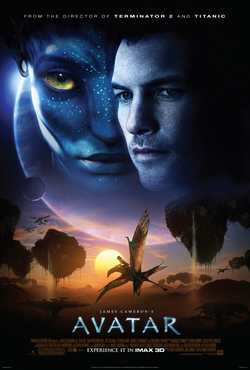 Theatrical release poster | |
| Directed by | James Cameron |
| Written by | James Cameron |
| Produced by |
|
| Starring |
|
| Cinematography | Mauro Fiore |
| Edited by |
|
| Music by | James Horner |
Production companies |
|
| Distributed by | 20th Century Fox |
Release dates |
|
Running time | 162 minutes |
| Countries |
|
| Language | English |
| Budget | $237 million |
| Box office | $2.924 billion |
Development of Avatar began in 1994, when Cameron wrote an 80-page treatment for the film. Filming was due to take place after the completion of Cameron's 1997 film Titanic, for a planned release in 1999; however, according to Cameron, the necessary technology was not yet available to achieve his vision of the film. Work on the fictional constructed language of the Na'vi began in 2005, and Cameron began developing the screenplay and fictional universe in early 2006.Avatar was budgeted at $237 million, due to the groundbreaking array of new visual effects Cameron achieved in cooperation with Weta Digital. Some estimates put the cost at between $280 million and $310 million for production, and at $150 million for promotion. The film made extensive use of 3D computer graphics and new motion capture filming techniques, and reunited Cameron with his Titanic co-producer Jon Landau.
Avatar premiered at the Odeon Leicester Square theater in London on December 10, 2009, and was released in the United States on December 18 by 20th Century Fox. The film received positive reviews from critics, who praised its groundbreaking visual effects, though the plot received criticism for being derivative. The film broke several box office records, including becoming the highest-grossing film of all time, surpassing Titanic. It also became the first film to gross more than $2 billion, and was the best-selling video title of 2010 in the United States. Adjusted for inflation, Avatar grossed around $4 billion, making it the second-highest-grossing film of all time, behind Gone with the Wind (1939).
Avatar received nine nominations at the 82nd Academy Awards, winning three awards, and received numerous other accolades. The success of the film led to an increase in popularity of 3D films, and to electronics manufacturers releasing 3D televisions.Avatar was followed by the sequels Avatar: The Way of Water (2022) and Avatar: Fire and Ash (2025), with two more sequels in development.
Plot
In 2154, Earth suffers from resource exhaustion and ecological collapse. The Resources Development Administration (RDA) mines the valuable mineral unobtanium on Pandora, a lush habitable moon in the Alpha Centauri star system. Pandora is inhabited by the Na'vi, a 10-foot-tall (3.0 m), blue-skinned, sapient humanoid species that live in harmony with nature.
To explore Pandora, human scientists control Na'vi-human hybrid bodies called "avatars". Each avatar is genetically matched with a human operator. Jake Sully, a paraplegic veteran of the United States Marines, is recruited as an operator after the death of his identical twin, who was training as an operator. The head of the Avatar Program, Dr. Grace Augustine, allows Jake to take the place of his twin, but considers him inadequate.
While Jake, Grace and Dr. Norm Spellman are in their avatars in the forest, Jake is attacked by wild animals. He flees deep into the wilderness, where he is rescued by a female Na'vi named Neytiri. Suspicious of Jake, she takes him to her clan, the Omaticaya. Mo'at, the clan's spiritual leader and the mother of Neytiri, orders her daughter to initiate Jake into their society.
Colonel Miles Quaritch, head of the RDA's security force, promises Jake that the company will restore the use of his legs if he provides information about the Na'vi and their gathering place, the giant Hometree, which sits atop a rich deposit of unobtanium. Jake and Neytiri fall in love as Jake is initiated into the clan, and they choose each other as mates. When Jake attempts to disable a bulldozer threatening a sacred Na'vi site, RDA administrator Parker Selfridge orders the destruction of Hometree.
Grace explains to Selfridge that destroying Hometree would damage the biological neural network that connects all Pandoran life, which prompts Selfridge to reluctantly give Jake and Grace one hour to convince the Na'vi to evacuate. Jake confesses to the Na'vi that he was a spy for the RDA, which prompts the clan to take him and Grace captive. Quaritch's soldiers destroy Hometree and kill many Na'vi, including Eytukan, who is the clan chief and Neytiri's father. Mo'at frees Jake and Grace, but they are detached from their avatars and imprisoned by Quaritch's forces. Trudy Chacón, a pilot who is disgusted by Quaritch's brutality, rescues Jake, Grace, and Norm. During the escape, Grace is shot and fatally wounded.
Jake regains the trust of the Na'vi by connecting his mind to the Toruk, a dragon-like creature feared and revered by the clan. Supported by Neytiri and the new chief Tsu'tey, Jake unites the Omaticaya, and tells them to gather other Na'vi clans to fight the RDA as it prepares to assault the Tree of Souls. Before the battle, Jake prays to the Na'vi mother goddess Eywa through a neural connection with the Tree of Souls.
The Na'vi and their human allies lose many fighters during the battle, including Tsu'tey and Trudy. The tide turns when wild animals unexpectedly join the fight and overwhelm the RDA forces; Neytiri interprets this occurrence as Eywa answering Jake's prayer. Quaritch, in an Amplified Mobility Platform suit, breaks open the avatar link unit containing Jake's human body, exposing it to Pandora's poisonous atmosphere. As Quaritch prepares to kill Jake, he is slain by Neytiri, who then saves Jake from suffocation.
In the aftermath of the war, the RDA is expelled from Pandora. Some humans are allowed to remain, including Jake and Norm. With the help of the Tree of Souls, Neytiri, and Mo'at, Jake is permanently transferred into his avatar.
Cast
- Sam Worthington as Jake Sully: A disabled former U.S. Marine who joins the Avatar Program to replace his deceased twin brother.
- Zoe Saldaña as Neytiri: A fierce Na'vi warrior. She teaches Jake about the Na'vi culture and later falls in love with him.
- Stephen Lang as Colonel Miles Quaritch: The commander of the RDA security forces.
- Michelle Rodriguez as Captain Trudy Chacón: A combat pilot assigned to support the Avatar Program who is sympathetic to the Na'vi.
- Giovanni Ribisi as Parker Selfridge: The corporate administrator of the RDA mining operation.
- Joel David Moore as Dr. Norm Spellman: A "xenoanthropologist" who studies plant and animal life as part of the Avatar Program.
- CCH Pounder as Mo'at: The Omaticaya's spiritual leader, Neytiri's mother, and Eytukan's wife.
- Wes Studi as Eytukan: The chief of the Omatikaya clan, Mo'at's husband, and Neytiri's father.
- Laz Alonso as Tsu'tey: The finest warrior of the Omaticaya, he is heir to the chieftainship of the tribe.
- Sigourney Weaver as Dr. Grace Augustine: An exobiologist and head of the Avatar Program.
- Dileep Rao as Dr. Max Patel: A scientist who works in the Avatar Program and comes to support Jake's rebellion against the RDA.
- Matt Gerald as Corporal Lyle Wainfleet: An RDA soldier and Quaritch's right-hand man.
Alicia Vela-Bailey appears in three uncredited roles: Ikeyni, the leader of the Tayrangi clan; Saeyla, a young Na'vi hunter; and a woman who is harassed in a bar. Vela-Bailey also served as Saldaña's stunt double.
Production
Development

In 1994,Avatar director James Cameron wrote an 80-page treatment for the film, drawing inspiration from science fiction books he read in his childhood, as well as from adventure novels by Edgar Rice Burroughs and H. Rider Haggard. He was also influenced by a dream he had when he was 19 years old, which included a bioluminescent forest with fiber-optic trees, fan lizards, and purple moss that lit up when stepped on. In August 1996, Cameron announced that after completing Titanic, he would direct Avatar, a science-fiction film that would feature computer-generated characters. The visual effects studio Digital Domain joined the project, which was supposed to begin production in mid-1997 for a 1999 release. However, Cameron felt that available technology had not caught up with his vision for the film. He put Avatar on hold for several years, and focused on refining the necessary technology and making documentaries. Eventually, the technological advances used in the creation of computer-generated characters such as Gollum (2002), King Kong (2005), and Davy Jones (2006) helped convince Cameron that he could realize his vision for Avatar.
20th Century Fox had committed to produce Avatar, but the studio was afraid of cost overruns and delays, which had plagued Cameron's previous film, Titanic. Fox fronted $10 million to Cameron to create a proof of concept clip for Avatar, which he showed to executives in October 2005. According to Cameron, the executives were excited about the clip, but they still wanted a shorter script and a smaller budget for the film than what Cameron had proposed. In response to these concerns, Cameron combined several characters in the screenplay. He also offered to cut his salary in half, and said he would take a lower percentage of the film's revenues if it was a commercial failure. Fox was still unconvinced, and in mid-2006 decisively declined to produce the film, according to Cameron.
Cameron then approached Walt Disney Studios, showing his Avatar clip to Disney CEO Bob Iger, then-studio chairman Dick Cook, and Alan Bergman. However, when Disney attempted to take over the project, Fox exercised its right of first refusal and committed to making Avatar in October 2006. Ingenious Media agreed to back the film, reducing Fox's financial exposure to less than half of the film's official $237 million budget. Fox planned to spend $150 million on marketing and make use of about $30 million in tax credits to further lessen the financial impact on the studio and its financiers. After Fox accepted Avatar, one skeptical executive told Cameron, "I don't know if we're crazier for letting you do this, or if you're crazier for thinking you can do this ..."
Design
Even before Avatar was funded, Cameron had begun working with a handful of designers, including the fantasy illustrator Wayne Barlowe and the concept artist Jordu Schell, to shape the design of the Na'vi. The designers used paintings and physical sculptures because Cameron felt that 3D renderings were not capturing his vision.Paul Frommer, a linguist at USC, was recruited to create a language for the Na'vi. The language has a lexicon of about 1000 words, with some 30 contributed by Cameron. Its phonemes include ejective consonants similar to those found in Amharic.
In July 2006, Cameron announced that he would film Avatar for a mid-2008 release, with principal photography beginning in February 2007. Designer Stan Winston, who had worked with Cameron in the past, joined the production, as did the visual effects studio Weta Digital.Production design for the film took several years. Avatar had two different production designers, Rick Carter and Robert Stromberg, and two separate art departments, one of which focused on the flora and fauna of Pandora, and another that designed the human-made machines depicted in the film. The production team also consulted with Jodie S. Holt, a professor of plant physiology at the University of California, Riverside. She offered ideas about how scientists, such as Sigourney Weaver's character Grace Augustine, might study plants on an alien world. She also helped the design team conceive of ways that organisms on Pandora might communicate with each other. In September, The Washington Post reported that Cameron would be using his own Reality Camera System to film Avatar in 3D. The system would employ two high-definition cameras in a single camera body to create depth perception.
Casting


Chris Evans, Chris Pine, Chris Pratt and Channing Tatum were considered for the role of Jake Sully.Matt Damon was a candidate, but the production schedule of Avatar conflicted with his work on The Bourne Ultimatum (2007). 20th Century Fox pushed for Jake Gyllenhaal to play the part, but Gyllenhaal was focused on Prince of Persia: The Sands of Time (2010).Sam Worthington, at the time a relatively unknown actor, became frustrated after several secretive auditions—he was not told what the film was about or who was directing. He had an angry outburst, which caught the attention of Cameron, who was seeking an actor with a certain amount of "grit". Cameron said that Worthington had two contradictory but necessary qualities for the role—toughness and vulnerability. In addition to playing Jake, Worthington briefly appears as Jake's deceased identical twin, Dr. Tom "Tommy" Sully. Worthington signed on for potential sequels.
Before casting Zoe Saldaña as Neytiri, Cameron considered Q'orianka Kilcher for the role. Since Saldaña was cast early in production, she helped screen-test actors auditioning for the part of Jake, including her eventual co-star Worthington. Neytiri, like all the Na'vi, was created using performance capture, and her outward appearance is entirely computer generated. Like Worthington, Saldaña signed on for potential sequels.
Cameron approached Josh Brolin for the role of Miles Quaritch, but Brolin did not want to commit to a lengthy shoot.Stephen Lang, who had unsuccessfully auditioned for a role in Cameron's Aliens (1986), was cast instead.Michael Biehn, who had worked with Cameron on Aliens, The Terminator (1984) and Terminator 2: Judgment Day (1991), was also briefly considered for the role.
Filming
Principal photography for Avatar began in 2007. Motion-capture filming occurred at the Hughes Aircraft stage in Playa Vista, Los Angeles, while live-action filming took place in Wellington on the soundstages of Weta Digital. Due to Cameron's personal convictions about climate change, he allowed only plant-based food to be served on set. The actors had been trained in skills specific to their characters, including archery, horseback riding, firearm use, hand-to-hand combat, and the Na'vi language. Before shooting began on the soundstage, Cameron sent the cast to Hawaii to get a feel for a rainforest setting. Cameron described the film as a "true hybrid"—a fully live-action shoot combined with computer-generated characters in both digital and live-action environments. According to Cameron, the film is composed of 60% computer-generated elements and 40% live action elements, and he hoped that audiences would be unable to tell the difference between the two when viewing the film.
The live action footage was shot with a modified version of the proprietary digital 3D Fusion Camera System developed by Cameron and Vince Pace. In January 2007, Fox had announced that 3D filming for Avatar would be done at 24 frames per second, despite Cameron's belief that 3D requires a higher frame rate to make strobing less noticeable. Cameron also utilized his virtual camera system, a new way of directing motion-capture performances. The system provided real-time viewing of actors in digital settings, allowing directors to adjust scenes while shooting. According to Cameron, "It's like a big, powerful game engine. If I want to fly through space, or change my perspective, I can. I can turn the whole scene into a living miniature and go through it on a 50-to-1 scale." He described the system as a "form of pure creation where if you want to move a tree or a mountain or the sky or change the time of day, you have complete control over the elements". Cameron gave the directors Steven Spielberg and Peter Jackson a chance to test the new technology. Spielberg said, "I like to think of it as digital makeup, not augmented animation ... Motion capture brings the director back to a kind of intimacy that actors and directors only know when they're working in live theater."
Visual effects

A number of innovative visual effects techniques were used during production. According to Cameron, work on the film had been delayed since the 1990s to allow the techniques to reach the necessary degree of advancement to adequately realize his vision of the film. He planned to make use of photorealistic computer-generated characters, created using new motion capture animation technologies he had been developing in the 14 months leading up to December 2006.
Innovations included a new system for lighting massive areas like Pandora's jungle, a motion-capture stage six times larger than any previously used, and an improved method for capturing facial expressions, enabling full performance capture. To achieve the face capturing, actors wore skull caps fitted with a tiny camera positioned in front of the actors' faces; the information collected about their facial expressions and eyes was then transmitted to computers. According to Cameron, the method allowed the filmmakers to transfer 100% of the actors' physical performances to their digital counterparts. There were also numerous reference cameras which gave the digital artists multiple angles of each performance.
The lead visual effects company was Weta Digital in Wellington, which at one point employed 900 people working on the film. Because of the tremendous amount of data which needed to be stored, cataloged and made available to various crew members—some of whom were stationed remotely—a new cloud computing and Digital Asset Management (DAM) system named Gaia was created by Microsoft especially for Avatar, which allowed the crew to keep track of and coordinate all stages of digital processing. To render Avatar, Weta used a 930 m2 (10,000 sq ft) server farm with 4,000 Hewlett-Packard servers. A new texturing and paint software system, called Mari, was developed by The Foundry in cooperation with Weta. Creating the Na'vi characters and the virtual world of Pandora required over a petabyte of digital storage, and each minute of the final footage for Avatar occupies 17.28 gigabytes of storage. It would often take the computer several hours to render a single frame of the film. To finish the special effects sequences on time, a number of other companies were brought on board, including Industrial Light & Magic, which worked alongside Weta to create the battle sequences. ILM was responsible for the visual effects for many of the film's vehicles and devised a new way to make CGI explosions.Joe Letteri was the film's visual effects general supervisor.
Music

James Horner composed the musical score for Avatar, his third collaboration with Cameron after Aliens and Titanic. He worked with Wanda Bryant, an ethnomusicologist, to create a music culture for the Na'vi, and recorded parts of the score with a small chorus singing in the Na'vi language in March 2008. Horner promised Cameron that he would devote his attention solely to Avatar and no other projects, and he reportedly worked on the score from four in the morning until ten at night throughout the process. He stated in an interview that it was the most difficult scored he had worked on. He composed the score as two different scores merged into one. He first created a score that reflected the Na'vi way of sound and then combined it with a separate "traditional" score to drive the film.Leona Lewis sang the theme song for the film, called "I See You". An accompanying music video, directed by Jake Nava, premiered December 15, 2009, on MySpace.
Themes and inspirations
In 2012, in response to several lawsuits alleging that Cameron based Avatar on other people's ideas, Cameron filed a 45-page legal declaration describing the origins of the ideas, themes, storylines, and characters of Avatar. In addition to historical events (such as European colonization of the Americas), his life experiences and several of his unproduced projects, Cameron drew connections between Avatar and his previous films. He cited his script and concept art for Xenogenesis, partially produced as a short film, as being the basis for many of the ideas and visual designs in Avatar. He stated that Avatar's "concepts of a world mind, intelligence within nature, the idea of projecting force or consciousness using an avatar, colonization of alien planets, greedy corporate interests backed up by military force, the story of a seemingly weaker group prevailing over a technologically superior force, and the good scientist were all established and recurrent themes" from his earlier films including Aliens, The Abyss, Rambo: First Blood Part II, The Terminator and Terminator 2: Judgment Day. He specifically mentioned the "water tentacle" in The Abyss as an example of an "avatar" that "takes on the appearance of...an alien life form...in order to bridge the cultural gap and build trust."
Cameron also cited a number of works by other creators as "reference points and sources of inspiration" for Avatar. These include two of his "favorite" films, 2001: A Space Odyssey, where mankind experiences an evolution after meeting alien life, and Lawrence of Arabia, where "an outsider...encounters and immerses into a foreign culture and then ultimately joins that group to fight other outsiders." Cameron said he became familiar with the concept of a human operating a "synthetic avatar" inside another world from George Henry Smith's short story "In the Imagicon" and Arthur C. Clarke's novel The City and the Stars. He said he learned of the term "avatar" by reading the cyberpunk novels Neuromancer by William Gibson and Islands in the Net by Bruce Sterling. The idea of a "world mind" originated in the novel Solaris by Stanislaw Lem. Cameron mentioned several other films about people interacting with "indigenous cultures" as inspiring him, including Dances with Wolves, The Man Who Would Be King, The Mission, The Emerald Forest, Medicine Man, The Jungle Book and FernGully. He also cited as inspiration the John Carter and Tarzan stories by Edgar Rice Burroughs and other adventure stories by Rudyard Kipling and H. Rider Haggard.
Cameron has described Avatar as "an action-adventure journey" and "a journey of self-discovery". He said imperialism is a theme. Cameron said the film was inspired by "every single science fiction book" he read in his youth, and that he wanted to update the style of Edgar Rice Burroughs' John Carter series. He acknowledged that Avatar shares themes with the films At Play in the Fields of the Lord, The Emerald Forest, and Princess Mononoke, which feature clashes between cultures and civilizations, and with Dances with Wolves, where a battered soldier finds himself drawn to the culture he was initially fighting against. He said Princess Mononoke (1997) influenced the ecosystem of Pandora, while Ghost in the Shell influenced the avatars that can be remotely controlled by humans.
In a 2007 interview with Time magazine, Cameron was asked about the meaning of the term Avatar, to which he replied, "It's an incarnation of one of the Hindu gods taking a flesh form. In this film what that means is that the human technology in the future is capable of injecting a human's intelligence into a remotely located body, a biological body."

Long before Cameron started work on Avatar, his mother told him of a dream she had which featured a blue-skinned woman 12 feet (4 m) tall. Cameron liked the image and created a race of "gorgeous" tall blue people with golden eyes for his first screenplay (written in 1976 or 1977). He created some paintings of these people, and when he was developing Avatar he drew upon this early work as inspiration for the Na'vi. Another reason Cameron cited for making the Na'vi blue is that it connects them to Hindu deities.
For the love story between characters Jake and Neytiri, Cameron applied a star-crossed love theme, which he said was in the tradition of Romeo and Juliet. He acknowledged its similarity to the pairing of Jack and Rose from his film Titanic. An interviewer stated: "Both couples come from radically different cultures that are contemptuous of their relationship and are forced to choose sides between the competing communities." Cameron described Neytiri as his "Pocahontas", saying that his plotline followed the historical story of a "white outsider [who] falls in love with the chief's daughter, who becomes his guide to the tribe and to their special bond with nature." Cameron felt that whether or not the Jake and Neytiri love story would be perceived as believable partially hinged on the physical attractiveness of Neytiri's alien appearance, which was developed by considering her appeal to the all-male crew of artists. Although Cameron felt Jake and Neytiri do not fall in love right away, Worthington and Saldaña felt the characters did. Cameron said the two actors had "great chemistry" during filming.

According to production designer Dylan Cole, the film's floating "Hallelujah Mountains", were inspired mainly by karst limestone formations in the Guilin, Huangshan and Zhangjiajie regions of China.
To create the interiors of the mining colony, production designers visited the Clyde Boudreaux oil platform in the Gulf of Mexico during June 2007. They photographed, measured and filmed every aspect of the interior of the platform, which was then replicated on-screen with CGI during post-production.
Cameron said that he wanted to make "something that has this spoonful of sugar of all the action and the adventure and all that" but also have a conscience "that maybe in the enjoying of it makes you think a little bit about the way you interact with nature and your fellow man". He added that "the Na'vi represent something that is our higher selves, or our aspirational selves, what we would like to think we are" and that even though there are good humans within the film, the humans "represent what we know to be the parts of ourselves that are trashing our world and maybe condemning ourselves to a grim future".
Cameron acknowledges that Avatar implicitly criticizes the United States' role in the Iraq War and the impersonal nature of mechanized warfare in general. In reference to the use of the term "shock and awe" in the film, Cameron said: "We know what it feels like to launch the missiles. We don't know what it feels like for them to land on our home soil, not in America." He said in later interviews, "... I think it's very patriotic to question a system that needs to be corralled ..." and, "The film is definitely not anti-American." Cameron has acknowledged that the fiery destruction of the Na'vi Hometree bears a resemblance to the September 11 attacks on the World Trade Center.
In July 2024, Cameron stated the film "resembled the Manhattan Project... making up new physics as we went along. Mastering a brand new methodology to tell stories." Cameron also acknowledged that it was actually film co-producer Jon Landau who was "the heart of the Avatar family."
Marketing
Promotions

In July 2009, Cameron, producer Jon Landau, Zoe Saldaña, Stephen Lang, and Sigourney Weaver promoted Avatar at San Diego Comic-Con, where 25 minutes of the film was screened in Dolby 3D. On August 21, which was dubbed "Avatar Day", the first trailer was released; toys related to the film and a trailer for an Avatar video game were also unveiled. The Avatar film trailer was viewed four million times the first day it was available online, a record at the time. On October 30, to celebrate the opening of Megastar Cinema, the first 3D cinema in Vietnam, Fox allowed the theater to screen an exclusive 16 minutes of Avatar for selected journalists. Two days later, a new trailer premiered live during a Dallas Cowboys football game at Cowboys Stadium in Arlington, Texas, on the Diamond Vision screen, one of the world's largest video displays, and to television audiences viewing the game on Fox. It was the largest live motion picture trailer viewing in history at the time.
The Coca-Cola Company collaborated with Fox to launch a global marketing campaign for the film. The centerpiece of the campaign was the website AVTR.com. Specially marked bottles and cans of Coca-Cola Zero, when held in front of a webcam, enabled users to interact with the website's 3D features using augmented reality (AR) technology. The film was also promoted in the Fox series Bones during the episode "The Gamer In The Grease".McDonald's had a promotion mentioned in television commercials in Europe called "Avatarize yourself", which directed viewers to a website where they could create a Na'vi version of themselves. A week prior to the U.S. release, Zoe Saldaña promoted the film on Adult Swim.
Books
Several Avatar-related books were published ahead of the film's release. Harper Entertainment released a field guide to Pandora titled Avatar: A Confidential Report on the Biological and Social History of Pandora. HarperFestival published James Cameron's Avatar: The Reusable Scrapbook for children, and Abrams Books released The Art of Avatar and The Making of Avatar. Following the release of the film, Cameron and producer Jon Landau stated in interviews that Cameron planned to write a novelization of Avatar and also a prequel novel. In 2013, Cameron hired Steven Gould to write four standalone novels to expand the Avatar universe. None of the announced novels have been published.
Video game
In 2007, Cameron chose Ubisoft Montreal to develop an Avatar video game, with Cameron ultimately using some of Ubisoft's vehicle and creature designs in the film.Avatar: The Game was released on December 1, 2009, for PlayStation 3, Xbox 360, Wii, Nintendo DS, iPhone and Microsoft Windows, and on December 8 for PlayStation Portable.[additional citation(s) needed]
Other merchandise
Several other merchandising promotions occurred in December 2009, the month of the film's release. France Post released a limited edition Avatar postage stamp, and a series of Avatar toys was distributed globally in McDonald's Happy Meals.Mattel released a line of Avatar action figures, each of which had an "i-TAG", which customers could scan using a webcam to reveal bonus content.
Release
Theatrical
Initial screening
Avatar premiered in London on December 10, 2009, and was released theatrically worldwide from December 16 to 18. The film was originally set for release on May 22, 2009, during filming, but was pushed back to allow more post-production time — the last shots were delivered in November — and give more time for theaters worldwide to install 3D projectors. Cameron stated that the film's aspect ratio would be 1.78:1 for 3D screenings and that a 2.39:1 image would be extracted for 2D screenings. However, a 3D 2.39:1 extract was approved for use with constant-image-height screens, i.e., screens that increase in width to display 2.39:1 films. During a 3D preview showing in Germany on December 16, the movie's DRM "protection" system malfunctioned, and some copies delivered weren't watched at all in the theaters. The problems were fixed in time for the public premiere.
Avatar was released in a total of 3,457 theaters in the United States, of which 2,032 theaters showed it in 3D. In total, 90% of all advance ticket sales for Avatar were for 3D screenings. Internationally, Avatar opened on a total of 14,604 screens in 106 territories, of which 3,671 were showing the film in 3D, producing 56% of the first weekend gross. The film was simultaneously presented in IMAX 3D format, opening in 178 theaters in the United States on December 18. The international IMAX release included 58 theaters beginning on December 16, and 25 more theaters were to be added in the coming weeks. The IMAX release was the company's widest to date, a total of 261 theaters worldwide. The previous IMAX record opening was Harry Potter and the Half-Blood Prince, which opened in 161 IMAX theaters in the US, and about 70 international. 20th Century Fox Korea adapted and later released Avatar in 4D version, which included "moving seats, smells of explosives, sprinkling water, laser lights and wind".
Post-original release
In July 2010, Cameron confirmed that there would be an extended theatrical rerelease of the film on August 27, 2010, exclusively in 3D theaters and IMAX 3D.Avatar: Special Edition includes an additional nine minutes of footage, all of which is CG, including an extension of the non-explicit sex scene and various other scenes that were cut from the original theatrical film. This extended re-release resulted in the film's run time approaching the then-current IMAX platter maximum of 170 minutes, thereby leaving less time for the end credits. Cameron stated that the nine minutes of added scenes cost more than $1 million a minute to produce and finish. During its 12-week re-release, Avatar: Special Edition grossed an additional $10.74 million in North America and $22.46 million overseas for a worldwide total of $33.2 million. The film was later re-released in China in March 2021, allowing it to surpass Avengers: Endgame to become the highest-grossing film of all time.
Avatar was rereleased in theaters on September 23, 2022, by Walt Disney Studios Motion Pictures for a limited two-week engagement, with the film being remastered in 4K high-dynamic range, with select scenes at a high frame rate of 48 fps. The reissue was prior to the December 2022 premiere of its sequel, Avatar: The Way of Water. Prior to this, Cameron previously teased a re-release of the film back in 2017 when promoting the Dolby Cinema re-release of Titanic, stating that there were plans in the works to remaster the film with Dolby Vision and re-release it in Dolby Cinema.
Home media
20th Century Fox Home Entertainment released the film on DVD and Blu-ray in the United States on April 22, 2010, and in the United Kingdom on April 26. The United States release was not on a Tuesday as is the norm, but was done to coincide with Earth Day. The first DVD and Blu-ray release does not contain any supplemental features other than the theatrical film and the disc menu in favor of and to make space for optimal picture and sound. The release also preserves the film's 1.78:1 (16:9) format over the 2.39:1 (21:9) scope version, as Cameron felt that was the best format to watch the film. The Blu-ray disc contains DRM (BD+ 5) which some Blu-ray players might not support without a firmware update.
Avatar set a first-day launch record in the United States for Blu-ray sales at 1.5 million units sold, breaking the record previously held by The Dark Knight (600, 000 units sold). First-day DVD and Blu-ray sales combined were over four million units sold. In its first four days of release, sales of Avatar on Blu-ray reached 2.7 million in the United States and Canada – overtaking The Dark Knight to become the best ever selling Blu-ray release in the region. The release later broke the Blu-ray sales record in the United Kingdom the following week. In its first three weeks of release, the film sold a total of 19.7 million DVD and Blu-ray discs combined, a new record for sales in that period. As of July 18, 2012, DVD sales (not including Blu-ray) totaled over 10.5 million units sold with $190, 806, 055 in revenue.Avatar retained its record as the top-selling Blu-ray in the US market until January 2015, when it was surpassed by Disney's Frozen.
The Avatar three-disc Extended Collector's Edition on DVD and Blu-ray was released on November 16, 2010. Three different versions of the film are present on the discs: the original theatrical cut (162 minutes), the special edition cut (170 minutes), and a collector's extended cut (178 minutes). The DVD set spreads the film across two discs, while the Blu-ray set presents it on a single disc. The collector's extended cut contains eight more minutes of footage, thus making it 16 minutes longer than the original theatrical cut. Cameron mentioned, "you can sit down, and in a continuous screening of the film, watch it with the Earth opening". He stated the "Earth opening" is an additional 4+1⁄2 minutes of scenes that were in the film for much of its production but were ultimately cut before the film's theatrical release. The release also includes an additional 45 minutes of deleted scenes and other extras.
Cameron initially stated that Avatar would be released in 3D around November 2010, but the studio issued a correction: "3-D is in the conceptual stage and Avatar will not be out on 3D Blu-ray in November." In May 2010, Fox stated that the 3D version would be released some time in 2011. It was later revealed that Fox had given Panasonic an exclusive license for the 3D Blu-ray version and only with the purchase of a Panasonic 3DTV. The length of Panasonic's exclusivity period is stated to last until February 2012. In October 2010, Cameron stated that the standalone 3D Blu-ray would be the final version of the film's home release and that it was "maybe one, two years out". On Christmas Eve 2010, Avatar had its 3D television world premiere on Sky.
On August 13, 2012, Cameron announced on Facebook that Avatar would be released globally on Blu-ray 3D. The Blu-ray 3D version was finally released on October 16, 2012.
On February 2, 2024, the film became available to stream in variable high frame rate in 3D 4K Dolby Vision on the Disney+ app for the Apple Vision Pro.
Reception
Critical response
On review aggregator Rotten Tomatoes, 81% of 335 reviews are positive, and the average audience score is 4.1 out of 5 stars. The site's consensus reads: "It might be more impressive on a technical level than as a piece of storytelling, but Avatar reaffirms James Cameron's singular gift for imaginative, absorbing filmmaking." On Metacritic—which assigns a weighted mean score—the film has a score of 83 out of 100 based on 38 critics. Audiences polled by CinemaScore gave the film an average grade of "A" on an A+ to F scale. Every demographic surveyed was reported to give this rating. These polls also indicated that the main draw of the film was its use of 3D.
Roger Ebert of the Chicago Sun-Times called the film "extraordinary", and gave it four stars out of four. "Watching Avatar, I felt sort of the same as when I saw Star Wars in 1977," he said, adding that like Star Wars and The Lord of the Rings: The Fellowship of the Ring, the film "employs a new generation of special effects" and it "is not simply a sensational entertainment, although it is that. It's a technical breakthrough. It has a flat-out Green and anti-war message".A. O. Scott of At The Movies also compared his viewing of the film to the first time he viewed Star Wars and he said "although the script is a little bit ... obvious," it was "part of what made it work". Todd McCarthy of Variety praised the film, saying: "The King of the World sets his sights on creating another world entirely in Avatar, and it's very much a place worth visiting." Kirk Honeycutt of The Hollywood Reporter gave the film a positive review. "The screen is alive with more action and the soundtrack pops with more robust music than any dozen sci-fi shoot-'em-ups you care to mention," he stated.Peter Travers of Rolling Stone awarded Avatar a three-and-a-half out of four star rating, and wrote in his print review: "It extends the possibilities of what movies can do. Cameron's talent may just be as big as his dreams."Richard Corliss of Time thought that the film was "the most vivid and convincing creation of a fantasy world ever seen in the history of moving pictures."Kenneth Turan of the Los Angeles Times thought the film has "powerful" visual accomplishments but "flat dialogue" and "obvious characterization".James Berardinelli of ReelViews praised the film and its story, giving it four out of four stars. He wrote: "In 3-D, it's immersive — but the traditional film elements — story, character, editing, theme, emotional resonance, etc. — are presented with sufficient expertise to make even the 2-D version an engrossing 2+1⁄2-hour experience."
Avatar's underlying social and political themes attracted attention. Armond White of the New York Press wrote that Cameron used "villainous American characters" to "misrepresent facets of militarism, capitalism, and imperialism".Russell D. Moore of The Christian Post concluded that "propaganda exists in the film" and stated "If you can get a theater full of people in Kentucky to stand and applaud the defeat of their country in war, then you've got some amazing special effects."Adam Cohen of The New York Times was more positive about the film, calling its anti-imperialist message "a 22nd-century version of the American colonists vs. the British, India vs. the Raj, or Latin America vs. United Fruit".Ross Douthat of The New York Times opined that the film is "Cameron's long apologia for pantheism [...] Hollywood's religion of choice for a generation now", while Saritha Prabhu of The Tennessean called the film a "misportrayal of pantheism and Eastern spirituality in general", and Maxim Osipov of The Hindustan Times, on the contrary, commended the film's message for its overall consistency with the teachings of Hinduism in the Bhagavad Gita.Annalee Newitz of io9 concluded that Avatar is another film that has the recurring "fantasy about race" whereby "some white guy" becomes the "most awesome" member of a non-white culture.Michael Phillips of the Chicago Tribune called Avatar "the season's ideological Rorschach blot", while Miranda Devine of The Sydney Morning Herald thought that "It [was] impossible to watch Avatar without being banged over the head with the director's ideological hammer." Nidesh Lawtoo believed that an essential, yet less visible social theme that contributed to Avatar's success concerns contemporary fascinations with virtual avatars and "the transition from the world of reality to that of virtual reality".
Critics and audiences have cited similarities with other films, literature or media, describing the perceived connections in ways ranging from simple "borrowing" to outright plagiarism. Ty Burr of The Boston Globe called it "the same movie" as Dances with Wolves. Like Dances with Wolves, Avatar has been characterized as being a "white savior" movie, in which a "backwards" native people is impotent without the leadership of a member of the invading white culture. Parallels to the concept and use of an avatar are in Poul Anderson's 1957 novelette "Call Me Joe", in which a paralyzed man uses his mind from orbit to control an artificial body on Jupiter. Cinema audiences in Russia have noted that Avatar has elements in common with the 1960s Noon Universe novels by Arkady and Boris Strugatsky, which are set in the 22nd century on a forested world called Pandora with a sentient indigenous species called the Nave. Various reviews have compared Avatar to the films FernGully: The Last Rainforest,Pocahontas and The Last Samurai.NPR's Morning Edition has compared the film to a montage of tropes, with one commentator stating that Avatar was made by "mixing a bunch of film scripts in a blender".Gary Westfahl wrote that "the science fiction story that most closely resembles Avatar has to be Ursula Le Guin's novella The Word for World Is Forest (1972), another epic about a benevolent race of alien beings who happily inhabit dense forests while living in harmony with nature until they are attacked and slaughtered by invading human soldiers who believe that the only good gook is a dead gook". The science fiction writer and editor Gardner Dozois said that along with the Anderson and Le Guin stories, the "mash-up" included Alan Dean Foster's 1975 novel, Midworld. Some sources saw similarities to the artwork of Roger Dean, which features fantastic images of dragons and floating rock formations. In 2013, Dean sued Cameron and Fox, claiming that Pandora was inspired by 14 of his images. Dean sought damages of $50m. Dean's case was dismissed in 2014, and The Hollywood Reporter noted that Cameron had won multiple Avatar idea theft cases.
Avatar received compliments from filmmakers, with Steven Spielberg praising it as "the most evocative and amazing science-fiction movie since Star Wars" and others calling it "audacious and awe inspiring", "master class", and "brilliant". Noted art director-turned-filmmaker Roger Christian is also a noted fan of the film. On the other hand, Duncan Jones said: "It's not in my top three James Cameron films. ... [A]t what point in the film did you have any doubt what was going to happen next?". For French filmmaker Luc Besson, Avatar opened the doors for him to now create an adaptation of the graphic novel series Valérian and Laureline that technologically supports the scope of its source material, with Besson even throwing his original script in the trash and redoing it after seeing the film.TIME ranked Avatar number 3 in their list of "The 10 Greatest Movies of the Millennium (Thus Far)" also earning it a spot on the magazine's All-Time 100 list, and IGN listed Avatar as number 22 on their list of the top 25 Sci-Fi movies of all time.
Box office
General
Avatar was released internationally on more than 14,000 screens. It grossed $3,537,000 from midnight screenings in the United States and Canada, with the initial 3D release limited to 2,200 screens. The film grossed $26,752,099 on its opening day, and $77,025,481 over its opening weekend, making it the second-largest December opening ever behind I Am Legend, the largest domestic opening weekend for a film not based on a franchise (topping The Incredibles), the highest opening weekend for a film entirely in 3D (breaking Up's record), the highest opening weekend for an environmentalist film (breaking The Day After Tomorrow's record), and the 40th-largest opening weekend in North America, despite a blizzard that blanketed the East Coast of the United States and reportedly hurt its opening weekend results. The film also set an IMAX opening weekend record, with 178 theaters generating approximately $9.5 million, 12% of the film's $77 million (at the time) North American gross on less than 3% of the screens.
International markets generating opening weekend tallies of at least $10 million were for Russia ($19.7 million), France ($17.4 million), the UK ($13.8 million), Germany ($13.3 million), South Korea ($11.7 million), Australia ($11.5 million), and Spain ($11.0 million).Avatar's worldwide gross was US$241.6 million after five days, the ninth largest opening-weekend gross of all time, and the largest for a non-franchise, non-sequel and original film. 58 international IMAX screens generated an estimated $4.1 million during the opening weekend.
Revenues in the film's second weekend decreased by only 1.8% in domestic markets, marking a rare occurrence, grossing $75,617,183, to remain in first place at the box office and recording what was then the biggest second weekend of all time. The film experienced another marginal decrease in revenue in its third weekend, dropping 9.4% to $68,490,688 domestically, remaining in first place at the box office, to set a third-weekend record.
Avatar crossed the $1 billion mark on the 19th day of its international release, making it the first film to reach this mark in only 19 days. It became the fifth film grossing more than $1 billion worldwide, and the only film of 2009 to do so. In its fourth weekend, Avatar continued to lead the box office domestically, setting a new all-time fourth-weekend record of $50,306,217, and becoming the highest-grossing 2009 release in the United States, beating Transformers: Revenge of the Fallen. In the film's fifth weekend, it set the Martin Luther King Day weekend record, grossing $54,401,446, and set a fifth-weekend record with a take of $42,785,612. It held the top spot to set the sixth and seventh weekend records grossing $34,944,081 and $31,280,029 respectively. It was the fastest film to gross $600 million domestically, on its 47th day in theaters.
On January 31 it became the first film to gross over $2 billion worldwide, and it became the first film to gross over $700 million in the United States and Canada, on February 27, after 72 days of release. It remained at number one at the domestic box office for seven consecutive weeks – the most consecutive No. 1 weekends since Titanic spent 15 weekends at No.1 in 1997 and 1998 – and also spent 11 consecutive weekends at the top of the box office outside the United States and Canada, breaking the record of nine consecutive weekends set by Pirates of the Caribbean: Dead Man's Chest. By the end of its first theatrical release Avatar had grossed $749,766,139 in the U.S. and Canada, and $1,999,298,189 in other territories, for a worldwide total of $2,749,064,328.
Including the revenue from a re-release of Avatar featuring extended footage, Avatar grossed $785,221,649 in the U.S. and Canada, and $2,137,696,265 in other countries for a worldwide total of $2,922,917,914.Avatar has set a number of box office records during its release: on January 25, 2010, it surpassed Titanic's worldwide gross to become the highest-grossing film of all time worldwide 41 days after its international release, just two days after taking the foreign box office record. On February 2, 47 days after its domestic release, Avatar surpassed Titanic to become the highest-grossing film of all time in Canada and the United States. It became the highest-grossing film of all time in at least 30 other countries and is the first film to gross over $2 billion in foreign box office receipts. IMAX ticket sales account for $243.3 million of its worldwide gross, more than double the previous record. By 2022, this figure rose to $268.6 million.
Box Office Mojo estimates that after adjusting for the rise in average ticket prices, Avatar would be the 14th-highest-grossing film of all time in North America. Box Office Mojo also observes that the higher ticket prices for 3D and IMAX screenings have had a significant impact on Avatar's gross; it estimated, on April 21, 2010, that Avatar had sold approximately 75 million tickets in North American theaters, more than any other film since 1999's Star Wars: Episode I – The Phantom Menace. On a worldwide basis, when Avatar's gross stood at $2 billion just 35 days into its run, The Daily Telegraph estimated its gross was surpassed by only Gone with the Wind ($3.0 billion), Titanic ($2.9 billion), and Star Wars ($2.2 billion) after adjusting for inflation to 2010 prices, with Avatar ultimately winding up with $2.92 billion after subsequent re-releases.Reuters even placed it ahead of Titanic after adjusting the global total for inflation. The 2015 edition of Guinness World Records lists Avatar only behind Gone with the Wind in terms of adjusted grosses worldwide.
Commercial analysis
Before its release, various film critics and fan communities predicted the film would be a significant disappointment at the box office, in line with predictions made for Cameron's previous blockbuster Titanic. This criticism ranged from Avatar's film budget, to its concept and use of 3-D "blue cat people".Slate magazine's Daniel Engber complimented the 3D effects but criticized them for reminding him of certain CGI characters from the Star Wars prequel films and for having the "uncanny valley" effect.The New York Times noted that 20th Century Fox executives had decided to release Alvin and the Chipmunks: The Squeakquel alongside Avatar, calling it a "secret weapon" to cover any unforeseeable losses at the box office.
Box office analysts, on the other hand, estimated that the film would be a box office success. "The holy grail of 3-D has finally arrived," said an analyst for Exhibitor Relations. "This is why all these 3-D venues were built: for Avatar. This is the one. The behemoth." The "cautionary estimate" was that Avatar would bring in around $60 million in its opening weekend. Others guessed higher. There were also analysts who believed that the film's three-dimensionality would help its box office performance, given that recent 3D films had been successful.
Cameron said he felt the pressure of the predictions, but that pressure is good for film-makers. "It makes us think about our audiences and what the audience wants," he stated. "We owe them a good time. We owe them a piece of good entertainment." Although he felt Avatar would appeal to everyone and that the film could not afford to have a target demographic, he especially wanted hard-core science-fiction fans to see it: "If I can just get 'em in the damn theater, the film will act on them in the way it's supposed to, in terms of taking them on an amazing journey and giving them this rich emotional experience." Cameron was aware of the sentiment that Avatar would need significant "repeat business" just to make up for its budget and achieve box office success, and believed Avatar could inspire the same "sharing" reaction as Titanic. He said that film worked because, "When people have an experience that's very powerful in the movie theatre, they want to go share it. They want to grab their friend and bring them, so that they can enjoy it. They want to be the person to bring them the news that this is something worth having in their life."
After the film's release and unusually strong box office performance over its first two weeks, it was debated as the one film capable of surpassing Titanic's worldwide gross, and its continued strength perplexed box office analysts. Other films in recent years had been cited as contenders for surpassing Titanic, such as 2008's The Dark Knight, but Avatar was considered the first film with a genuine chance to do so, and its numbers being aided by higher ticket prices for 3D screenings did not fully explain its success to box office analysts. "Most films are considered to be healthy if they manage anything less than a 50% drop from their first weekend to their second. Dipping just 11% from the first to the third is unheard of," said Paul Dergarabedian, president of box-office analysis for Hollywood.com. "This is just unprecedented. I had to do a double take. I thought it was a miscalculation." Analysts predicted second place for the film's worldwide gross, but most were uncertain about it surpassing Titanic because "Today's films flame out much faster than they did when Titanic was released." Brandon Gray, president of Box Office Mojo, believed in the film's chances of becoming the highest-grossing film of all time, though he also believed it was too early to surmise because it had only played during the holidays. He said, "While Avatar may beat Titanic's record, it will be tough, and the film is unlikely to surpass Titanic in attendance. Ticket prices were about $3 cheaper in the late 1990s." Cameron said he did not think it was realistic to "try to topple Titanic off its perch" because it "just struck some kind of chord" and there had been other good films in recent years. He changed his prediction by mid-January. "It's gonna happen. It's just a matter of time," he said.
You've got to compete head on with these other epic works of fantasy and fiction, the Tolkiens and the Star Wars and the Star Treks. People want a persistent alternate reality to invest themselves in and they want the detail that makes it rich and worth their time. They want to live somewhere else. Like Pandora.
Although analysts have been unable to agree that Avatar's success is attributable to one primary factor, several explanations have been advanced. First, January is historically "the dumping ground for the year's weakest films", and this also applied to 2010. Cameron himself said he decided to open the film in December so that it would have less competition from then to January.Titanic capitalized on the same January predictability, and earned most of its gross in 1998. Additionally, Avatar established itself as a "must-see" event. Gray said, "At this point, people who are going to see Avatar are going to see Avatar and would even if the slate was strong." Marketing the film as a "novelty factor" also helped. Fox positioned the film as a cinematic event that should be seen in the theaters. "It's really hard to sell the idea that you can have the same experience at home," stated David Mumpower, an analyst at BoxOfficeProphets.com. The "Oscar buzz" surrounding the film and international viewings helped. "Two-thirds of Titanic's haul was earned overseas, and Avatar [tracked] similarly ...Avatar opened in 106 markets globally and was No. 1 in all of them", and the markets "such as Russia, where Titanic saw modest receipts in 1997 and 1998, are white-hot today" with "more screens and moviegoers" than before.
According to Variety, films in 3D accumulated $1.3 billion in 2009, "a threefold increase over 2008 and more than 10% of the total 2009 box-office gross". The increased ticket price – an average of $2 to $3 per ticket in most markets – helped the film. Likewise, Entertainment Weekly attributed the film's success to 3D glasses but also to its "astronomic word-of-mouth". Not only do some theaters charge up to $18.50 for IMAX tickets, but "the buzz" created by the new technology was the possible cause for sold-out screenings. Gray said Avatar having no basis in previously established material makes its performance remarkable and even more impressive. "The movie might be derivative of many movies in its story and themes," he said, "but it had no direct antecedent like the other top-grossing films: Titanic (historical events), the Star Wars movies (an established film franchise), or The Lord of the Rings (literature). It was a tougher sell ..."The Hollywood Reporter estimated that after a combined production and promotion cost of between $387 million and $437 million, the film turned a net profit of $1.2 billion.
Accolades
Avatar won the 82nd Academy Awards for Best Art Direction, Best Cinematography, and Best Visual Effects, and was nominated for a total of nine, including Best Picture and Best Director.Avatar also won the 67th Golden Globe Awards for Best Motion Picture – Drama and Best Director, and was nominated for two others. At the 36th Saturn Awards, Avatar won all ten awards it was nominated for: Best Science Fiction Film, Best Actor, Best Actress, Best Supporting Actor, Best Supporting Actress, Best Director, Best Writing, Best Music, Best Production Design and Best Special Effects.
The New York Film Critics Online honored the film with its Best Picture award. The film also won the Critics' Choice Awards of the Broadcast Film Critics Association for Best Action Film and several technical categories, out of nine nominations. It won two of the St. Louis Film Critics awards: Best Visual Effects and Most Original, Innovative or Creative Film. The film also won the British Academy of Film and Television Arts (BAFTA) award for Production Design and Special Visual Effects, and was nominated for six others, including Best Film and Director. The film has received numerous other major awards, nominations and honors.
Legacy
Despite the film's financial and critical success, some journalists have questioned Avatar's cultural impact. In 2014, Scott Mendelson of Forbes said the film had been "all but forgotten", citing the lack of merchandising, a fandom for the film, or any long-enduring media franchise, and further stated that he believed most general audiences could not remember any of the film's details, such as the names of its characters or actors in the cast. Mendelson argued Avatar's only achievement of note to be its popularization of 3D cinema. Despite this, he still felt it was a quality film, saying, "A great blockbuster movie can just be a great blockbuster movie without capturing the lunchbox market." He further reflected and reversed his stance in 2022 after the box office success of the re-release, saying, "The very things that made Avatar sometimes feel like a 'forgotten blockbuster' have inspired a skewed renewed nostalgia for its singular existence. It was just a movie, an original auteur-specific movie that prioritized top-shelf filmmaking and clockwork plotting over quotable dialogue and memes."
Some have questioned if there is an audience for the film's planned sequels, believing there to be a lack of interest in the face of the multiple delays of their release dates. Writing for The Escapist, Darren Mooney acknowledged that the film had not been broadly remembered in the pop cultural subconscious and had not found a fandom in the same sense as many other popular media, but argued that this was not a negative point, saying, "its defining legacy is the insistence that it lacks a legacy."
In 2022, in response to the trailer for Avatar's upcoming sequel and the film's re-release, journalists again questioned the cultural relevance of the film, particularly Patrick Ryan of USA Today, who said the film had "curiously left almost no pop-culture footprint". In contrast, Bilge Ebiri of Vulture called others' opinions that the film had left no cultural impact "narrow-minded" and said that the film still held up well. A detailed overview of the Avatar franchise was reported in The New York Times in December of that year.
Sequels
Avatar's success led to two sequels; this number was subsequently expanded to four.Avatar: The Way of Water (2022) grossed over $2.3 billion, becoming the highest-grossing film of 2022, and received a similarly positive critical and audience response. The most recent sequel, Avatar: Fire and Ash, was released in 2025; two more sequels are scheduled to be released in 2029 and 2031.
Related media
Stage adaptation
Toruk – The First Flight is an original stage production by the Montreal-based Cirque du Soleil which ran between December 2015 and June 2019. Inspired by Avatar, the story is set in Pandora's past, involving a prophecy concerning a threat to the Tree of Souls and a quest for totems from different tribes. Audience members could download an app in order to participate in show effects. On January 18, 2016, it was announced via the Toruk Facebook page that filming for a DVD release had been completed and was undergoing editing.
Theme park attraction
In 2011, Cameron, Lightstorm, and Fox entered an exclusive licensing agreement with Disney to feature Avatar-themed attractions at Walt Disney Parks and Resorts worldwide, including a themed land for Disney's Animal Kingdom in Lake Buena Vista, Florida. The area, known as Pandora – The World of Avatar, opened on May 27, 2017.